
Tactical Tuesdays: City Bodega The IT-Mart!
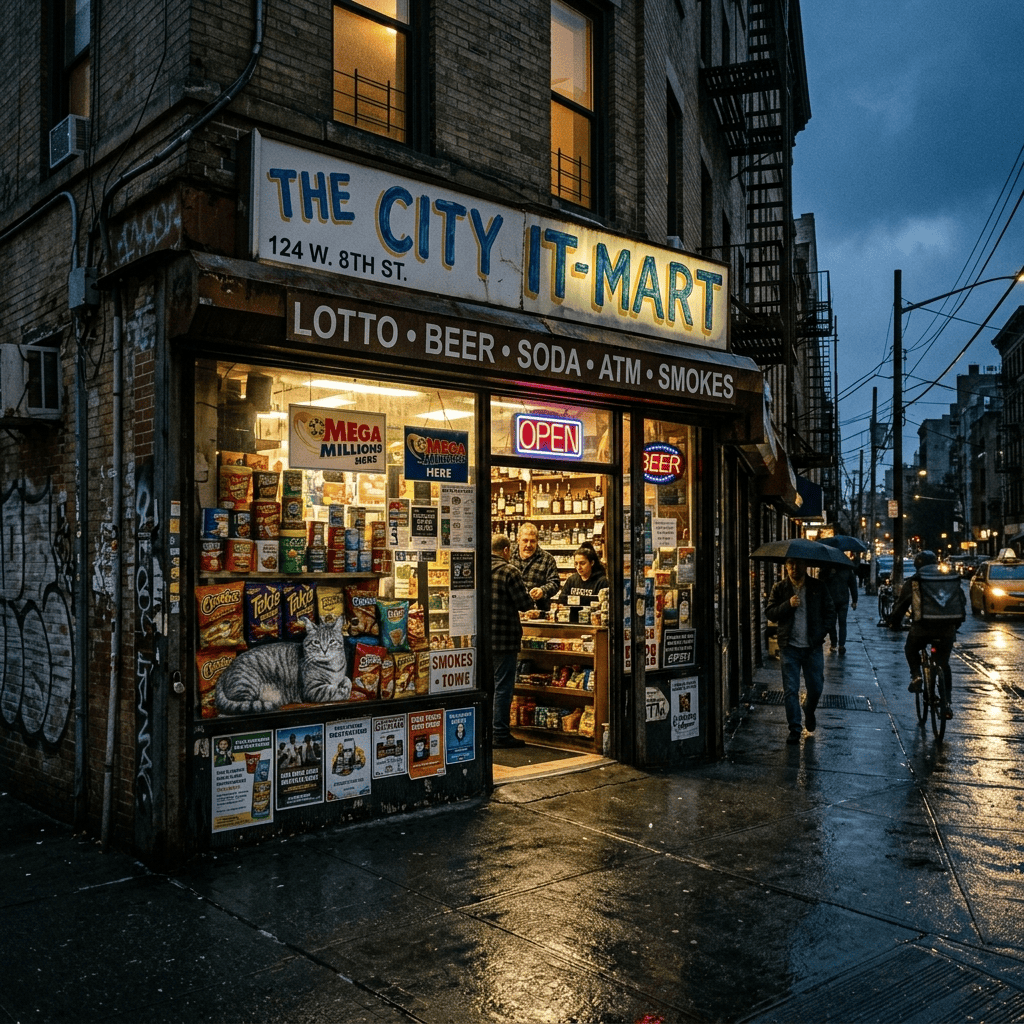
Tactical Tuesdays: Urban Set Piece — The City It-Mart™
“If You Want It, We Have It, at the City It-Mart”
Let me tell you about a place I keep tucked in my back pocket for damn near every urban game I run.
It ain’t a warehouse full of henchmen. It ain’t a mob boss’s smoky back room. It’s a corner store. And I promise you, before your campaign’s over, your players are going to know it better than their own apartments.
We call this one an Urban Set Piece. A location built to be used, reused, and remembered.
So let me set the stage.
What’s a Bodega, Anyway?
If you came up in the country like I did, you might not have a bodega on your radar. So let me draw the picture for you.
A bodega is a little corner store crammed into the ground floor of some old city building. It’s a grocery, sure — but that word doesn’t cover the half of it. You want milk at three in the morning? They’ve got it. You need a phone charger, a lottery ticket, a can of soup, a pack of smokes, a sandwich, and a birthday card, all in one stop? They’ve got that too.
A bodega is part grocery, part pharmacy, part hardware store, part pawn shop, part neighborhood living room. It’s open when everything else is locked up tight. And it runs on something no chain store can bottle — the store knows you. The folks behind the counter know your name, your habits, and probably a few of your secrets.
That’s the whole magic of it for a game. It’s a place where the neighborhood comes to breathe. And a neighborhood that breathes is a neighborhood full of stories.
The Staff — Meet the City It-Mart Crew
Now, the store’s only as good as the folks who run it. So let me introduce you.
Behind the counter is Sal Petrakis. Owner, operator, and unofficial keeper of secrets and wisdom for the block. Sal’s somewhere north of sixty, built like a fire hydrant, with forearms like knotted rope and a voice worn down to gravel from forty years of hollering over the noise of the city. He’s seen this neighborhood change three or four times over, and he remembers every version of it. Sal keeps a baseball bat under the register — but he’ll tell you, straight-faced, that he’s only ever had to use it twice, and both times he felt bad about it.
Sal doesn’t miss much. He’s the kind of man who can tell you who’s been acting funny lately, who owes money to who, and which car’s been parked across the street a little too long. For a Game Master, Sal is pure gold. He’s an information hub with a heartbeat.
Then there’s Marisol. She works the night shift, and she’s not asking your permission to be sharp about it. Early twenties, quick-mouthed, community college textbooks stacked next to the register between customers. She notices things Sal misses — the small stuff, the young stuff, the trouble brewing on the phones and in the shadows. If your players want the real pulse of the street, Marisol’s their girl. Assuming they’re polite. She has a long memory for people who aren’t.
And you can’t forget Old Deej. Deej isn’t staff, exactly, but he might as well have a name tag. He’s a regular who nurses a single cup of coffee for four hours a day, parked on an overturned milk crate near the door, watching the whole world go by. Half the neighborhood thinks he’s just a harmless old fixture. The sharp ones suspect Deej used to be somebody — and that he still knows more than he lets on. Whether that’s true is up to you, my friend. But a man who watches doors for a living tends to see who comes and goes.
There’s your cast. Three people, three story hooks, one counter.
Upstairs Above the Store
Here’s a detail folks always forget — Sal doesn’t go home at night. Sal is home.
There’s a small apartment right up above the It-Mart, up a narrow stairwell behind a door marked PRIVATE that Sal keeps locked. It’s a cramped little place. Lived-in. The kind of home a man builds over decades without ever meaning to decorate.
There are photographs on the walls going yellow at the edges — a younger Sal, a wife who isn’t around anymore, kids grown and gone to who-knows-where. A recliner worn into the exact shape of him. A window that looks straight down onto the street, where Sal sits some nights with the lights off, just watching. There’s a strongbox somewhere in that apartment. There’s a shotgun somewhere too. And there’s forty years of the neighborhood’s memory stacked up in shoeboxes.
That apartment matters. Because it means Sal has everything to lose right here. He’s not going anywhere. And that gives your players a man who can be threatened, protected, leaned on, or trusted — depending on how the story runs.
Don’t Forget the Cat
Every good bodega’s got a cat, and the It-Mart is no exception.
Her name is Duchess. She’s a fat gray tabby with one torn ear and the disposition of a landlord collecting rent. Duchess is a working animal, technically — she keeps the mouse population honest, and she earns her keep. But mostly she rules the place. She sleeps in the front window, in the sunbeam, on the good display of chips, wherever she pleases. Sal pretends to be annoyed by her. Everyone knows he loves that cat more than most people.
Here’s a Game Master’s trick worth remembering: Duchess notices things. If somebody dangerous walks in, Duchess bolts for the back. Let your sharp-eyed players catch that tell. A cat that suddenly won’t sit still is worth more than a whole speech about a bad feeling in the air.
How To Use It At Your Table
So what do you do with the City It-Mart? Plenty.
As neutral ground. Nobody starts a fight in Sal’s store. There’s an understanding on the block. That makes it the perfect place for enemies to meet, for tense conversations, for a truce that might not hold.
As an information hub. Need your players to catch a rumor, meet a contact, or overhear the wrong thing at the right time? Sal, Marisol, and Deej have you covered. This is where the neighborhood’s secrets get whispered.
As an inciting incident. Maybe your players walk in for a pack of gum and walk out with a mystery. A robbery goes down. Sal gets a threatening visit. A stranger leaves something behind the counter “for safekeeping.” Duchess bolts, and the trouble walks in the door.
As a recurring anchor. The best set pieces are the ones players return to. Let them build a relationship with Sal. Let them tip Marisol. Let them earn Duchess ignoring them a little less. When you finally do put the It-Mart in danger, it’ll land like a punch to the gut, because now it’s their place too.
That’s the whole point of a good Urban Set Piece. It’s not just a store. It’s a reason to care.
Drop the City It-Mart into your next session, give Sal that gravel voice, and watch what happens. If you want it, we’ve got it.
For more urban set pieces, pulp tools, and dirty tricks to run at your table, keep prowling Scaldcrow Games — the fire’s lit, and there’s always another story waiting on the corner.
If you would like to revisit past articles, look no further than the Geek Opera Index!
Watch the shadows, my friends. And always check your ale for poison.
This.
Wow, this is an amazing feature to add to any game. I am totally using it next session.