
Mazes & Mondays: 10 Epic Swords of Myth
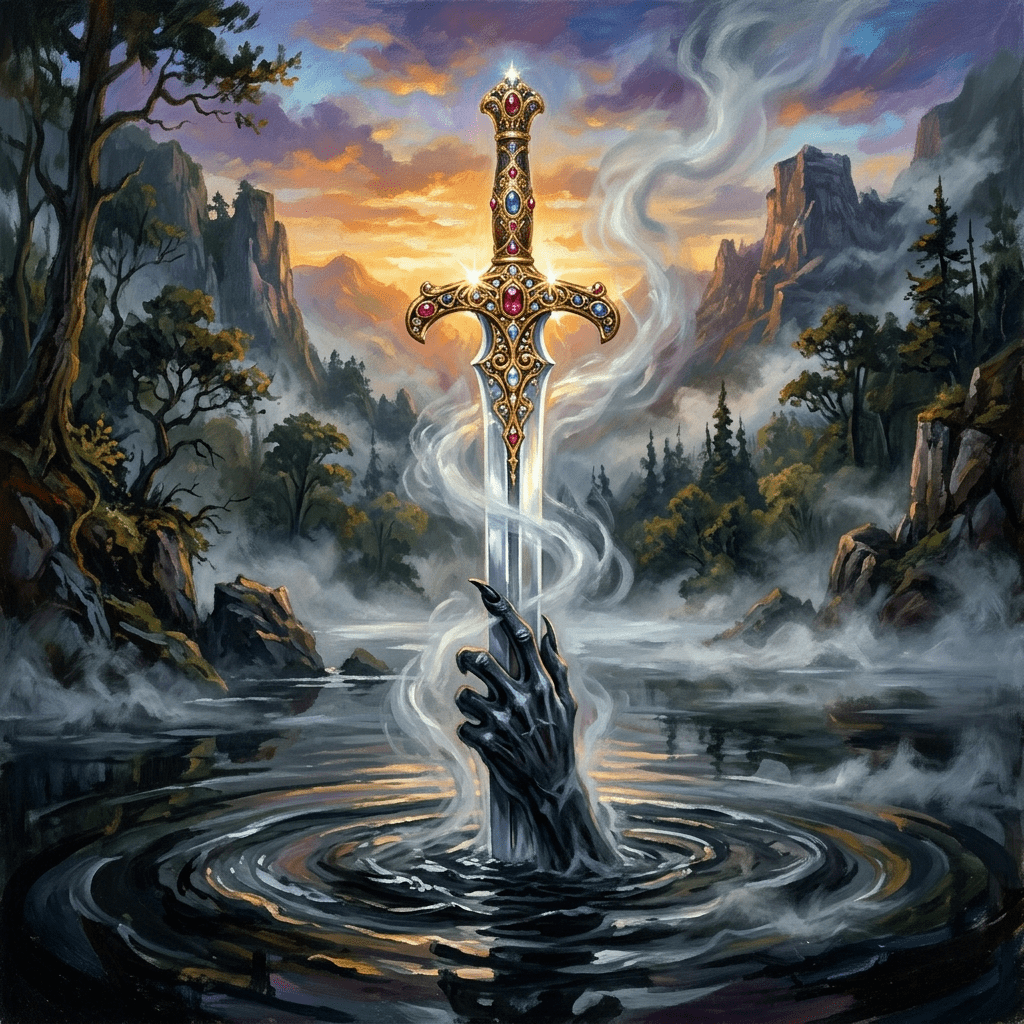
The Top 10 Most Spectacular Swords in Fantasy and Mythology
Some weapons are just tools. Others become legends. Across centuries of myth, epic, and storytelling, a handful of swords have earned names, personalities, and reputations that outlive the heroes who wielded them. These blades cut through more than flesh — they cut through history, shaping how we imagine courage, kingship, and destiny.
In this guide, you’ll meet ten of the most spectacular swords in fantasy-appropriate mythology. For each, you’ll learn where it came from, what it looked like, what made it extraordinary, and the heroes and stories that carried its name forward. Whether you’re a game master hunting for inspiration, a writer building a world, or simply a fan of legendary steel, these blades are the stuff great stories are made of.
Let’s draw them from their scabbards.
1. Excalibur — The King’s Blade
No list of legendary swords begins anywhere but here. Excalibur is the sword of King Arthur, drawn (in some tellings) from the stone, or gifted by the mysterious Lady of the Lake.
Picture a broad, straight double-edged blade of gleaming steel, its cross-guard and pommel worked in gold and set with gemstones that caught the light. In many tellings, the blade itself shone so brightly it dazzled Arthur’s enemies, blinding them like the glare of a dozen torches. Its scabbard, richly jeweled, was the true treasure — said to protect its bearer from losing a single drop of blood.
What makes it spectacular isn’t just its razor edge — it’s what it stood for. The sword symbolized rightful rule itself. Whoever held Excalibur held the very legitimacy of the throne. When Arthur fell at Camlann, he commanded the blade returned to the lake, where a hand rose from the water to reclaim it. That final image has haunted storytellers for over a thousand years.
2. Durandal — The Unbreakable Edge
Wielded by Roland, the greatest paladin of Charlemagne, Durandal was famed for its impossible durability. Legend claims the blade was so sharp and so strong that when a dying Roland tried to shatter it against the stone to keep it from enemy hands, it was the mountain rock that split — not the sword.
Imagine a long, tapered war-sword of bright, flawless steel — plain in the blade but unmistakable in the hilt. That golden hilt was its most striking feature, crafted to hold holy relics behind crystal or gold fittings: a tooth of Saint Peter, blood of Saint Basil, hairs of Saint Denis. Durandal was a weapon and a reliquary at once, embodying faith and martial glory in equal measure. A blade that could cleave stone and carry saints — few swords burn brighter in legend.
3. Gram — The Dragonslayer
From Norse myth comes Gram, the sword of the hero Sigurd. Reforged from the shattered blade of his father, Gram was so keen it could slice through an anvil and cut a tuft of wool drifting downstream against the current.
This was a broad, heavy Norse blade, its steel bearing the wavy, watered patterns of masterful forge-welding — the fractured pieces of the original weapon fused back into something greater. Some accounts describe a blade that glowed or gleamed with an unnatural sheen, marking it as no ordinary steel. Its greatest deed? Sigurd used Gram to slay the dragon Fafnir, striking upward from a hidden pit as the great serpent crawled overhead. Bathing in the dragon’s blood granted Sigurd near invulnerability — a scene echoed in countless fantasy epics since. Gram is the ancestor of every reforged hero’s blade you’ve ever cheered for.
4. Fragarach — The Answerer
Irish myth gives us Fragarach, “The Answerer” or “The Retaliator.” Forged by the gods and once wielded by Lugh and the sea god Manannán mac Lir, this blade held terrifying powers.
Envision a short, keen god-forged blade that seemed to carry the sea and sky within it — a shimmering, storm-touched sheen along the edge, as if wind moved across the metal. Slim and swift rather than massive, it looked more like an elegant tool of the divine than a brute’s weapon. Held to a foe’s throat, Fragarach could compel them to answer any question truthfully — no lie could stand against it. It cut through any armor or shield as if through air, and the winds themselves were said to obey its bearer. A sword that commanded truth and controlled the storm is a gift straight from the divine, and a perfect centerpiece for any mythic tale.
5. Joyeuse — The Sword of Many Colors
Joyeuse (“Joyful”) was the personal sword of Charlemagne himself. Legend describes a blade of shifting hues, changing color dozens of times a day, so dazzling it blinded those who beheld it.
This is the most visually astonishing sword on the list. Picture a long, kingly blade whose polished surface rippled with color — flashing from gold to green to blue and back, never settling on a single shade. Its pommel was fashioned of gold and, like Durandal, was said to hold a fragment of the Holy Lance sealed within. French kings were crowned with a sword called Joyeuse for centuries, cementing its place as a symbol of imperial power. A weapon that gleamed with color and coronated emperors — Joyeuse blended beauty and majesty like few blades ever have.
6. Curtana — The Sword of Mercy
Not every legendary blade is defined by its cutting power. Curtana, the Sword of Mercy, is famous for what it lacks: a broken, blunted tip.
Visually, Curtana is unforgettable precisely because it looks incomplete. Imagine a straight, dignified ceremonial blade of bright steel — and then, where the deadly point should taper to a needle, a clean, squared-off break. That flattened, snapped tip is its signature, a deliberate flaw carrying deep meaning. Associated with Ogier the Dane and later English coronation regalia, Curtana’s severed point symbolized the tempering of justice with mercy. In one tale, an angel stayed Ogier’s hand mid-vengeance, breaking the blade’s tip so the killing blow could not fall. A sword that teaches restraint carries a story every bit as powerful as one that teaches conquest.
7. Caladbolg — The Lightning Blade
The Irish hero Fergus mac Róich wielded Caladbolg, a two-handed sword whose name suggests “hard lightning” or “hard cleft.” When swung, it left an arc like a rainbow across the sky and could shear the tops off hills.
This was a massive, two-handed greatsword — long in the reach and heavy in the swing, demanding both hands and a hero’s strength. Its most spectacular feature wasn’t the steel itself but what it left behind: a shining, rainbow-colored arc trailing through the air with every stroke, as if the blade tore a wound in the sky. In the great epic Táin Bó Cúailnge, Fergus used Caladbolg to level three hilltops in his fury. This is a weapon of raw, apocalyptic force — the kind that reshapes the very landscape. Caladbolg is widely believed to be an inspiration for Excalibur’s own name, making it a hidden ancestor of the entire tradition.
8. Tyrfing — The Cursed Blade
For those who love their legends dark, Tyrfing delivers. This Norse sword was forged by dwarves under duress — and cursed in revenge. It could cut through stone and iron as easily as cloth, and it never missed its mark.
Picture a beautiful, deadly blade that shone like fire or the glow of the sun, its edges so perfectly keen they seemed to burn with light. The hilt was worked in gold, gorgeous enough to tempt any warrior to reach for it — which was exactly the trap. Beneath the beauty lay the curse: Tyrfing had to draw blood every time it was unsheathed, and it was fated to cause three great evils, dooming generations of its owners. Tyrfing is the ultimate cautionary tale: a weapon of unmatched power that consumes everyone who dares to claim it. Every cursed artifact in modern fantasy owes it a debt.
9. Kusanagi-no-Tsurugi — The Grasscutter
From Japanese mythology comes Kusanagi-no-Tsurugi, one of the three Imperial Regalia. The storm god Susanoo discovered it inside the tail of the eight-headed serpent Yamata-no-Orochi and presented it to the sun goddess Amaterasu.
Rather than the graceful, curved katana of later centuries, early depictions describe Kusanagi as a straight, single-edged blade of ancient bronze or iron — a tsurugi in the old style, plain and archaic yet radiating sacred weight. Some accounts speak of it drawn gleaming from the serpent’s tail, cleaner and brighter than any weapon the gods had seen. Its name, “Grass-Cutter,” comes from the hero Yamato Takeru, who used the blade to slash burning grass and redirect a wildfire against his enemies, escaping an ambush. Kusanagi represents divine legitimacy in Japanese legend, passed down as a sacred symbol of imperial rule. Few swords sit so close to the heart of a nation’s mythology.
10. Crocea Mors — The Yellow Death
Rounding out the list is Crocea Mors, or “Yellow Death,” the legendary sword of Julius Caesar as told in British legend by Geoffrey of Monmouth. According to the tale, the blade was so deadly that any wound it dealt proved fatal.
The name is the clue to its look: a Roman gladius-style sword, short and broad for close combat, with a golden gleam that gave it the “yellow” in its title. Whether from a gilded hilt, a bronze sheen, or the sunlit flash of polished metal, contemporaries described a blade that shone with an ominous golden light — beautiful and lethal in the same glance. It was later captured by the British prince Nennius, who wielded it against the Roman invaders before falling in battle — buried, the story says, with the fearsome sword at his side. Crocea Mors bridges history and myth, transforming a real conqueror’s weapon into a blade of supernatural lethality.
Why These Legendary Swords Still Captivate Us
Strip away the magic and the miracles, and these swords endure for one simple reason: they carry meaning. Excalibur is kingship. Curtana is mercy. Tyrfing is the danger of unchecked power. Gram is the triumph of the reforged hero. Each blade is a story compressed into steel — a symbol we can hold, name, and remember.
Their appearances matter just as much. A blade of shifting colors, a greatsword that paints rainbows across the sky, a broken tip that speaks of restraint — these visual details are what make a legendary sword unforgettable at a glance. When you can picture the weapon, you can picture the hero, and the whole story snaps into focus.
That’s why modern fantasy, from novels to films to tabletop adventures, keeps returning to the well of the legendary sword. A named blade gives a hero purpose and a world its history. When you hand a player character an ancestral weapon or write a sword that thirsts for blood, you’re drawing on thousands of years of storytelling instinct.
Ready to forge your own legend? Take one of these blades as inspiration, twist its origin, redesign how it looks, and drop it into your next story or campaign. The greatest swords in myth were never just weapons — they were characters. Give yours a name, a curse, a distinctive gleam, or a destiny, and watch your world come alive.
At Scaldcrow Games, crafting mythic weapons and unforgettable stories is exactly our specialty. Pick your favorite blade above, and start building the legend your table will remember.
Speciial thanks to Thersa Bane’s Encyclopedia of Mythological Objects.
If you would like to revisit past articles, look no further than the Geek Opera Index!
Watch the shadows, my friends. And always check your ale for poison.