
Mazes & Mondays: 10 Races of Myth
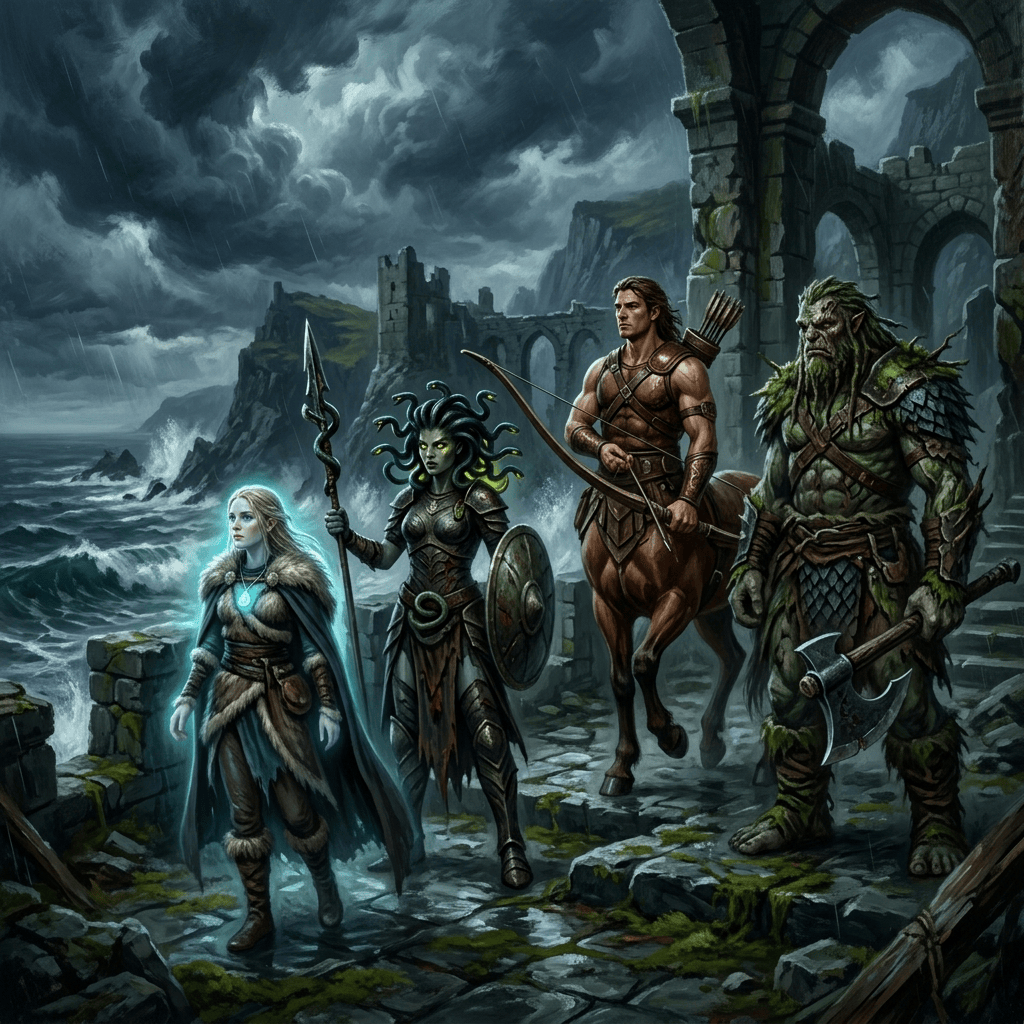
10 Mythological Races for Unforgettable TTRPG Characters
Every game master knows the moment. A player opens the core rulebook, scans the same worn-out ancestry list, and lets out a long sigh. Another elf. Another dwarf. Another half-orc named something that ends in “-gorn.” The classics have their place, but the myths of Greece, Japan, Scotland, Ireland, and the Anglo-Saxon world are packed with beings far stranger and more playable than the standard lineup.
These traditions gave us bull-headed titans, tiger-faced warriors, serpent-haired guardians, and seal-skinned wanderers torn between land and sea. Every one is a creature of solid flesh, bone, scale, or fur — no misty phantoms fading at dawn. And every one stands somewhere between human height and roughly twice that, giving your players real physical presence at the table.
Below you’ll find ten mythological races drawn from these five traditions. For each, you’ll get the origin, a physical description, why it makes a compelling player character, and roleplaying hooks ready to drop into your next session. Let’s build something your table won’t forget.
1. Tengu — The Crow-Warriors of Japan’s Mountains
Born from Japanese folklore, the Tengu began as fearsome bird-demons of the high peaks and grew into masters of martial skill. Picture a roughly human-sized figure — black feathers, sharp features, and folded wings at the back, sometimes marked by a long red nose. They stand as tall as a person but carry themselves like duelists who’ve never lost.
Tengu are proud, cunning, and famously deadly with a blade. Mythology names them the secret teachers of legendary swordsmen, drilling warriors in hidden mountain dojos.
Why they shine at the table: A Tengu makes a natural monk, duelist, or trickster fighter. Their mix of arrogance and discipline gives players a rich personality to lean into.
Roleplaying hooks: Play a Tengu who owes a life-debt to the human they trained — or one hunting the worthy student who might finally inherit their art.
2. Minotaur — The Horned Titans of the Labyrinth
Charging in from Greek mythology, the Minotaur pairs the head and horns of a bull with the towering, muscled body of a man. The original stalked the labyrinth beneath Crete, standing well over human height — easily seven feet or more of solid muscle. A Minotaur fills a doorway, and every step lands with weight.
These are creatures of raw physical presence, built to intimidate and endure.
Why they shine at the table: Minotaurs make outstanding barbarians, guardians, and front-line fighters. Horns, size, and strength translate cleanly into combat abilities.
Roleplaying hooks: Lean into the labyrinth legend — a being born to be feared, desperate to prove they’re more than the monster of the maze. That tension between reputation and character drives a whole campaign arc.
3. Selkie — The Seal-Skinned Wanderers of the North
From the misty coasts of Scotland, Ireland, and the northern isles come the Selkies, gentle shapeshifters who live as seals in the sea and shed their skins to walk as humans on land. In their human form they stand at human height, strikingly handsome, with dark eyes and an aching pull toward the ocean.
The heart of the Selkie legend is their sealskin. Lose it, and they’re trapped ashore. Reclaim it, and the sea calls them home forever.
Why they shine at the table: Selkies carry built-in emotional drama and make wonderful druids, rangers, or reluctant heroes torn between two worlds. Their aquatic side opens fun exploration and mechanical hooks.
Roleplaying hooks: Play a Selkie searching for a stolen sealskin — their literal freedom held hostage — or one who hid the skin themselves, choosing a life on land they now question.
4. Naga — The Serpent-Folk of Sacred Rivers
Weaving through Japanese and broader Asian legend, the Naga are half-human, half-serpent beings tied to water and hidden treasure. Picture a powerful humanoid torso rising from a long, muscular serpent’s tail, crowned with a cobra-like hood and scales that shimmer in jeweled tones. Their coiled length pushes them well beyond human size.
Naga guarded springs, rivers, and underground riches — some benevolent, some jealous and quick to punish.
Why they shine at the table: Their serpentine build creates fun mechanics — enhanced movement, constriction, striking reach — and suits sorcerers, oracles, and temple guardians.
Roleplaying hooks: A Naga driven from a defiled sacred spring, seeking to reclaim or avenge their lost waters, brings instant mystique and purpose.
5. Rakshasa — The Tiger-Faced Warriors
The Rakshasa prowl through epic mythology as powerful beings of flesh and fang, often shown with tiger-like faces, sharp claws, fanged mouths, and imposing, larger-than-human builds. Far from wispy phantoms, they are strong, cunning, embodied warriors and nobles who rule their own kingdoms.
In legend, Rakshasa command respect and dread alike, clashing with heroes as worthy adversaries.
Why they shine at the table: They bring feline grace and predatory power — excellent for fighters, warlocks, or scheming nobles.
Roleplaying hooks: A Rakshasa can embrace the role of the intimidating warrior or defy every expectation as an honorable outcast. Either way, the built-in reputation gives players plenty to push against.
6. Kitsune — The Fox-Folk of Cunning and Change
Another gem from Japanese folklore, the Kitsune are intelligent fox-beings who grow more powerful — and more tails — with age. A young one carries a single tail; a legend, nine. In human form they stand near human height, graceful and alluring, betrayed by a flick of ears, a hint of tail, or a golden gleam in the eye. Always a body of fur and flesh, never a phantom.
Kitsune are famous tricksters, yet also loyal companions and fierce guardians.
Why they shine at the table: Shapeshifting, illusion, and cunning make them perfect rogues, tricksters, and enchanters. The tail-based progression lets a player’s power visibly grow.
Roleplaying hooks: A Kitsune counting the tails they’ve yet to earn — or repaying a debt to a human who once showed them kindness — offers endless roleplaying range.
7. Centaur — The Untamed Riders of Greece
The Centaur of Greek mythology joins the upper body of a human to the powerful frame of a horse. Wild, strong, and fiercely independent, a Centaur stands taller and broader than any two-legged ancestry, with the mass and speed of a warhorse built in.
Greek legend cast them as both brutish revelers and wise teachers — the healer Chiron ranks among the greatest mentors in all mythology.
Why they shine at the table: Centaurs bring raw physical presence and unmatched speed. They make outstanding rangers, barbarians, and cavalry-style fighters.
Roleplaying hooks: The split in their mythology lets players choose their path — a battlefield charger seeking glory, or a learned sage guiding the party like Chiron before them.
8. Fomorian — The Rugged Giants of Irish Legend
From Irish mythology come the Fomorians, a race of powerful, misshapen giants tied to the wild and the sea. Older tales describe them as towering, rough-hewn beings — often standing eight or nine feet tall — some marked by a single eye, a single arm, or other striking features that set them apart from smooth-faced folk. They are creatures of storm-coast strength and ancient, stubborn will.
Cast in legend as rivals of the gods, the Fomorians ruled the land before newer powers pushed them to the margins.
Why they shine at the table: Their size and toughness make them natural barbarians, guardians, and front-line fighters, with an ancient outsider’s perspective baked in.
Roleplaying hooks: Play a Fomorian and last of their line, seeking to reclaim a stolen ancestral homeland — or one who abandoned their people’s old grudges to walk among the very folk they once fought.
9. Gorgon — The Serpent-Haired Guardians
The Gorgon slither out of Greek mythology as fearsome beings with a human form and a crown of living serpents — Medusa the most famous among them. Later folklore expands them into a whole race of serpent-haired guardians, human-sized but wreathed in writhing snakes, often with scaled skin and piercing eyes.
Feared for their petrifying gaze, Gorgons were also protectors, their images carved to ward off evil.
Why they shine at the table: A Gorgon suits rogues, guardians, and cunning spellcasters. Their snake-crowned appearance and mythic reputation make them unforgettable at a glance.
Roleplaying hooks: Play a Gorgon who’s learned to shield or master their dangerous gaze, wandering a world that sees only the monster. The struggle to be met with something other than terror gives real emotional stakes.
10. Grendelkin — The Fen-Dwelling Marauders of Anglo-Saxon Legend
We close with a race inspired by the monstrous line of Beowulf — the Grendelkin, descendants of the fen-dwelling beast Grendel and his fierce mere-dwelling mother. Picture a hulking, humanoid marauder well above human height, with tough hide, long clawed arms, and a heavy, powerful frame suited to the marshes and moors they call home. These are beings of pure, brooding physicality, shaped by cold water and lonely wilds.
Anglo-Saxon legend paints their ancestors as outcasts, driven to the edges of the mead-hall’s warm light.
Why they shine at the table: A Grendelkin makes a formidable barbarian, fighter, or grim guardian, with strength and reach that dominate the battle map.
Roleplaying hooks: Play a Grendelkin seeking a place at the very hearth-fires their bloodline was cast out from — or one carrying the weight of an old feud, choosing whether to end the cycle of vengeance or feed it.
Bring These Legends to Your Table
Greek, Japanese, Scottish, Irish, and Anglo-Saxon mythology hand you a treasure hoard of ancestries, and these ten only scratch the surface. A Minotaur proving they’re more than the maze’s monster, a Kitsune counting tails yet to grow, a Grendelkin seeking a place at the hearth — these aren’t just character options. They’re stories waiting to be played.
The best part? Every one comes with conflict, culture, and a solid physical form already baked in. No misty spirits to explain away — just beings of horn, scale, fur, and muscle your party can stand beside, spar with, and remember. The myths did the heavy lifting centuries ago. Your job is simply to open the door and let them step onto the battle map.
So next time a player groans at the same tired lineup, hand them this list instead. Pick a favorite, twist its legend to fit your world, and build the ancestry your table will still be talking about long after the campaign ends. Which of these would you roll up first?
At Scaldcrow Games, breathing new life into forgotten myths is exactly what we love to do. Choose a race above, roll up something unforgettable, and let the old legends ride again.
My go to source for mythological research is the McFarland collection of books by Theresa Bane
If you would like to revisit past articles, look no further than the Geek Opera Index!
Watch the shadows, my friends. And always check your ale for poison.