
Tactical Tuesdays: The Back Room…
Tactical Tuesday: The Back Room
Every pulp story has one. The speakeasy with the unmarked door behind the bar. The warehouse office where the boss counts his money. The private chamber past the throne where the real decisions get made. It goes by many names, but everyone at the table knows it the moment you mention it: the Back Room.
This is where deals are struck that never see daylight. Where secrets are locked away. Where a nervous lieutenant gets “taken in the back” for a conversation he won’t walk away from. The Back Room is one of the most loaded phrases in all of pulp fiction — and most GMs waste it with a single dismissive wave.
Today we fix that.
In this article, you’ll learn:
- Why the Back Room carries so much narrative weight
- The mistake most GMs make when players push toward it
- How to describe a Back Room that feels dangerous and real
- Two ready-to-use 2d6 tables to fill it with contents and drama
Why the Back Room Matters
The Back Room is a promise. When your players hear that a villain conducts “certain business in the back,” their imaginations go to work immediately. They picture ledgers full of blackmail, a captured ally tied to a chair, a map with red pins marking the next heist. You’ve spent nothing, and they’ve already built tension for you.
That’s the power of the space. It’s a container for consequence — the physical location where the campaign’s hidden truths live. Whoever controls the Back Room controls the secrets, and secrets are the currency of every good crime story.
The takeaway: the Back Room isn’t set dressing. It’s a treasure vault of plot, and your players know it.
The Mistake Most GMs Make
Here’s the trap. A player says, “I want to check the back room.” And the GM, caught flat-footed, says: “There’s nothing back there. Just some crates.”
You just deflated the whole scene.
The problem isn’t that the room was empty. The problem is that you promised something and delivered nothing. You built a legendary space with the word “back,” then treated it like a supply closet. Players feel that letdown, even if they can’t name it.
The fix is simple: never let the Back Room be nothing. It doesn’t need to be spectacular. A single ledger, a bloodstain on the floor, a phone left off the hook — any one of these keeps the promise. The Back Room should always reward curiosity with at least one hook, one clue, or one complication.
Common mistake to avoid: treating “the back” as an off-screen abstraction. If it’s important enough to name, it’s important enough to detail.
What a Back Room Looks and Feels Like
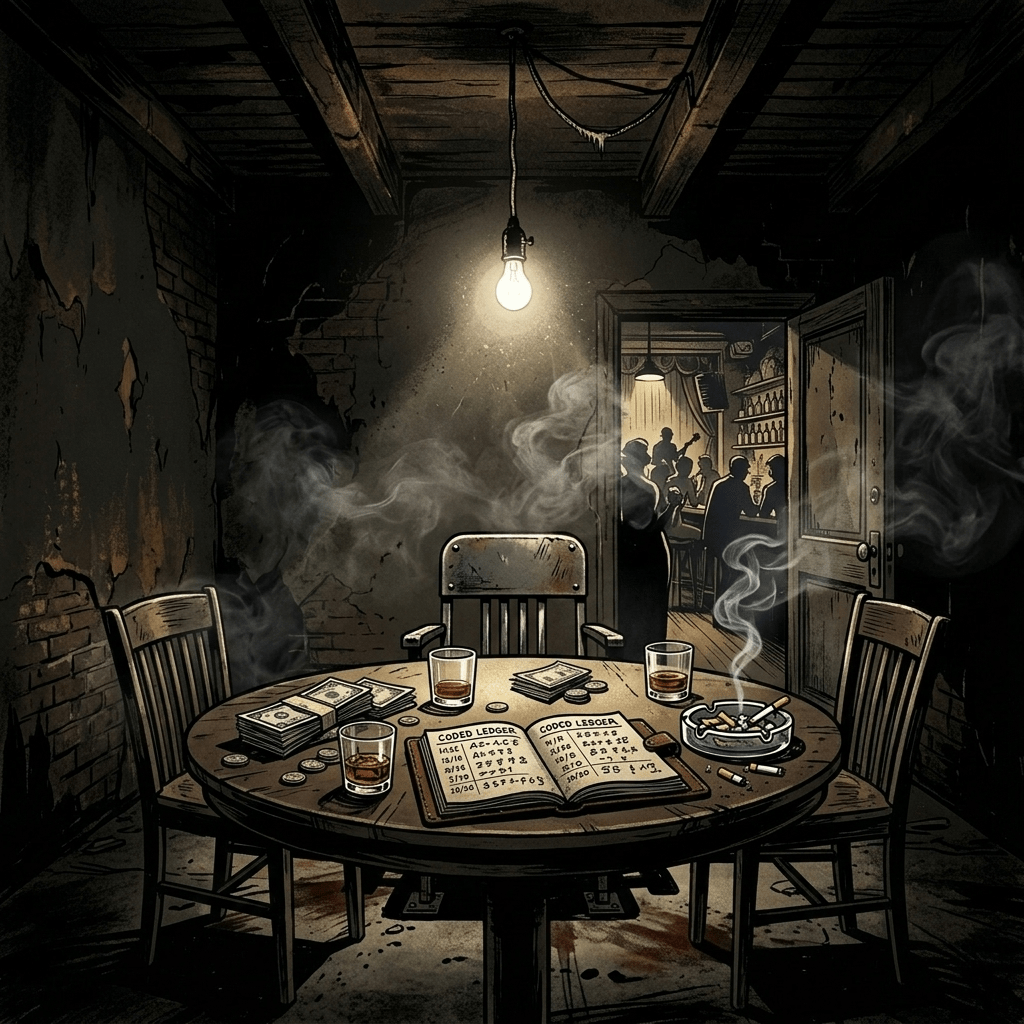
Picture the space. It’s smaller than the players expect — cramped, low-ceilinged, thick with the smell of cigarette smoke and old paper. One light source, usually harsh and unflattering: a bare bulb, a desk lamp, the flicker of a neon sign bleeding through a grimy window.
The furniture tells a story. A heavy desk scarred by decades of use. A safe, or the outline where a safe used to be. Mismatched chairs, one of them positioned a little too deliberately in the center of the room. The walls hold the details — a calendar, a pinned photo, a water stain shaped like something you’d rather not name.
Most of all, a good Back Room feels watched. It’s private for a reason. This is where the mask comes off, where the friendly barkeep or the smiling politician does the ugly work. That contrast — public charm, private menace — is the pulp engine, and the Back Room is where it lives.
Describe it in three quick strokes: the light, the smell, and the one detail that doesn’t belong. That’s all it takes to make players lean in.
Table 1: What’s in the Back Room (Roll 2d6)
Roll for the physical contents and features. These range from the mundane-but-useful to the darkly telling. Use one, or roll twice for a richer scene.
| 2d6 | What’s in the Back Room |
|---|---|
| 2 | A heavy floor safe, dial worn smooth from use — and fresh scratches around the hinges, as if someone tried to force it recently. |
| 3 | A single chair bolted to the floor, with rope fibers and a dark stain beneath it. Someone spent bad hours here. |
| 4 | Stacks of ledgers and receipts. Half are ordinary business; half are a second set of books in a private code. |
| 5 | A wall map of the district, marked with pins, string, and a circled address the players will recognize. |
| 6 | Crates of unremarkable goods — but one is nailed shut differently, hiding contraband, weapons, or a body. |
| 7 | A cluttered desk: half-drunk coffee, a smoldering cigarette, a phone off the hook. Someone left in a hurry, seconds ago. |
| 8 | A liquor cabinet with a false back, concealing cash, a pistol, or a bundle of incriminating letters. |
| 9 | A corkboard of photographs — surveillance shots of people the players know, some marked with a red X. |
| 10 | A locked filing cabinet full of blackmail: names, dates, and secrets that could topple half the city. |
| 11 | A back exit no one mentioned — a trapdoor, tunnel, or alley door that changes every escape and ambush in the building. |
| 12 | A hidden shrine, radio rig, or ritual setup revealing the villain’s true agenda, far bigger than the players guessed. |
Table 2: What’s Happening in the Back Room (Roll 2d6)
Roll for the secret, event, or situation unfolding as the players arrive — or the one that just ended. This is the drama the room is holding.
| 2d6 | What’s Happening in the Back Room |
|---|---|
| 2 | An execution, mid-sentence. The players walk in on the worst possible moment and must react now. |
| 3 | A prisoner is being “questioned.” They’re still alive, still useful — and desperate for rescue. |
| 4 | A tense deal is closing between two factions who both think they have the upper hand. |
| 5 | Someone is frantically burning documents in a metal bin. Save the evidence, or let it turn to ash. |
| 6 | A private meeting of lieutenants, arguing over a decision the boss hasn’t approved yet. Mutiny is brewing. |
| 7 | A quiet payoff — an official, a cop, or a “friend” of the party taking an envelope they shouldn’t. |
| 8 | A hushed phone call to a name the players didn’t know was involved. The conspiracy just got bigger. |
| 9 | A double-cross in progress: one ally here is about to betray another, and the players can tip the scales. |
| 10 | An emergency stash-and-run. Someone is cramming valuables into a bag, planning to vanish tonight. |
| 11 | A confession, whispered under duress, that rewrites what the players thought they knew about the case. |
| 12 | The true villain, unmasked, conducting business they never meant to be seen — a face that changes everything. |
Putting the Back Room to Work
The Back Room earns its legend because it delivers on a promise. When your players push through that unmarked door, give them something — a clue, a complication, a moment of horror or opportunity. Roll once on each table and you’ve got an instant scene: a scarred chair (Table 1, roll of 3) and a confession under duress (Table 2, roll of 11) tell a whole story before you say a word.
Here’s your next step. Pick your next villain’s hideout and decide, right now, what’s in their back room and what’s happening there. Jot it on an index card. When your players inevitably ask, you’ll be ready with menace instead of a shrug.
The best pulp GMs know that the space behind the curtain is where the real game lives. Treat it that way, and “let’s take this in the back” becomes a line your table will never forget.
At Scaldcrow Games, building the dark corners your players can’t resist exploring is exactly what we love to do. Roll up a Back Room, drop it into your next session, and let your villains do their worst.
If you would like to revisit past articles, look no further than the Geek Opera Index!
Duck the Alley Apples!