
Tactical Tuesdays: The Painted Grift
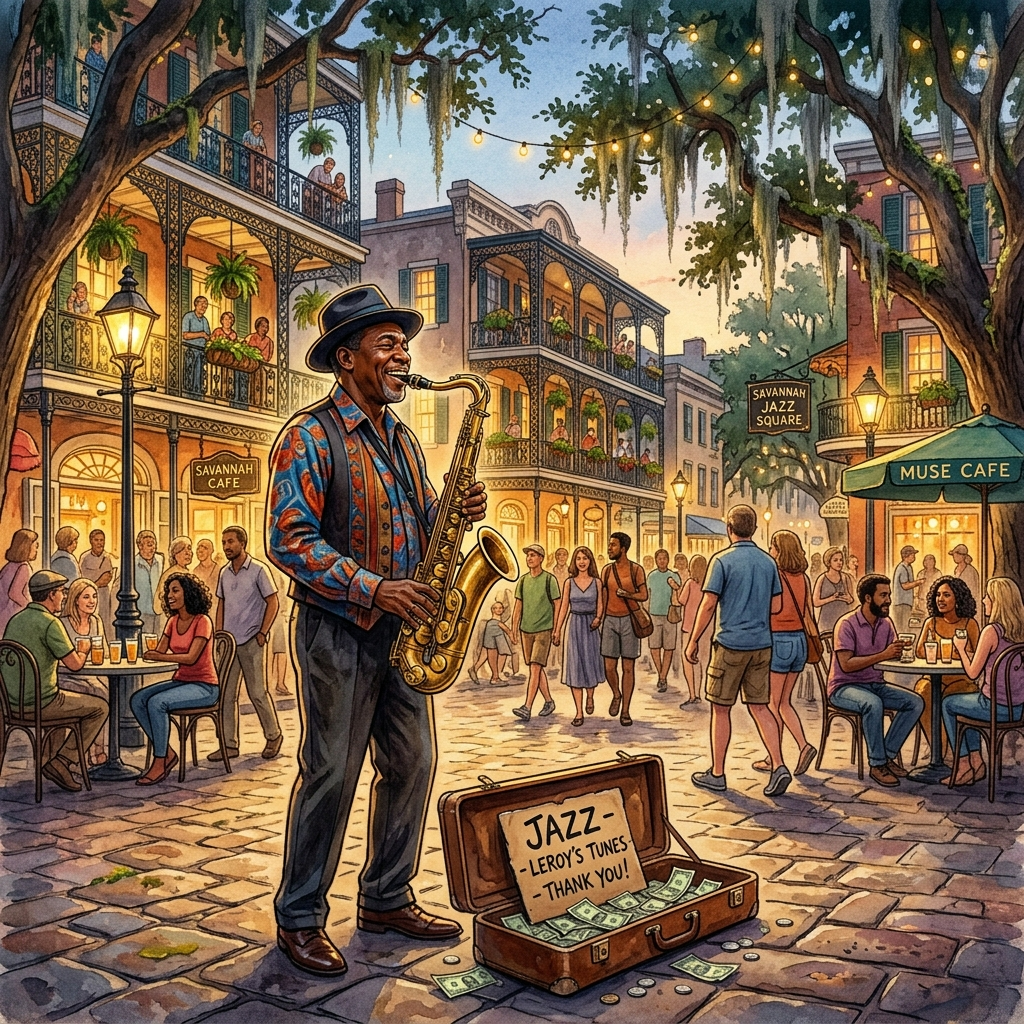
Tactical Tuesday: The Street Performer
I lived in Savannah, Georgia for nearly a decade, and if you know the city, you know its streets sing. Come the warm months, the squares filled up with performers of every stripe. A saxophone player would set up near a fountain and blow smooth street jazz into the humid evening air. A guy with trained parrots let tourists take photos while the birds squawked on command. Singers, magicians, costumed statues who held perfectly still until you tipped them, then snapped to life and scared you half to death. If it wasn’t happening in Savannah that day, it was happening somewhere — every touristy town has its buskers.
I watched these performers for years, and eventually I started wondering about them. Where did they go at night? Why choose a life of hat-money and hard pavement? Some were artists chasing a dream. But others? Others had the look of people who couldn’t fill out a job application without raising a red flag.
That’s the seed of a great NPC. Today we plant it.
In this article, you’ll learn:
- Why street performers make richer NPCs than most GMs realize
- How an act works as both cover and currency
- Ways to use performers as informants, contacts, and threats
- Three 2d6 tables, read together, to build one on the spot
Why the Street Performer Works
Think about what a street performer actually is. They stand in public all day, watching everyone who passes. They talk to strangers for a living. They read a crowd, work an angle, and move on before anyone asks too many questions. In game terms, that’s a walking information node with a built-in reason to notice things — and a built-in reason to keep quiet unless the price is right.
Compare that to the usual tavern-keeper or nameless guard your players tune out. The performer stands apart. They’re colorful, memorable, and mobile. They can show up in three different scenes and feel like the same living person. That kind of recurring face builds a world faster than any lore dump.
The takeaway: a street performer is a set of eyes, ears, and secrets, all wrapped in a package your players will actually remember.
The Act Is the Cover
Here’s the part that makes them dangerous to write and delightful to run. Many people choose street performing precisely because it dodges traditional employment. No background check. No paper trail. No boss asking where you were last year. For an honest artist, that freedom is the appeal. For someone with a past, it’s a hiding place.
A juggler might be a deserter who ran from a war he’d rather forget. A fortune teller might be working off a warrant three cities back. That charming magician pulling coins from behind a kid’s ear could be laundering more than card tricks — the crowd, the hat, the constant flow of small bills all make a fine screen for dirtier money.
So the act does double duty. It’s cover, hiding who they really are behind a persona nobody questions. And it’s currency, earning coin, goodwill, and access to conversations a stranger would never overhear. Understand both jobs the act is doing, and you understand the character.
Common mistake to avoid: treating a performer as pure flavor. If they’re worth naming, they’re worth a secret.
Putting Performers to Work at the Table
Once you know what a performer is hiding, you know how the players can use them — and how they can be used against the players.
As informants: A performer sees the daily traffic of a street. Who met whom, who looked nervous, which carriage rolled past twice. That intel comes at a price, usually coin or a favor, sometimes silence about what the performer is up to.
As contacts: A recurring busker who trusts the party becomes a soft anchor in a hostile city. They pass messages, hide small items, or point the group toward someone who can help. Their livelihood depends on being liked, so they’re natural relationship-builders.
As threats: The flip side is sharp. A performer with a criminal connection might be marking targets for a gang, working as a lookout, or lining up marks for a pickpocket crew. The friendly face that waves the party through today could be the one that fingered them for an ambush tonight.
The trick is to decide early which way a given performer leans — then let the players discover it the hard way.
Building One on the Fly
Below are three 2d6 tables meant to be rolled together. Roll once on each, and read the results as a single character: what they do, who they really are, and whether their act is clean or hiding teeth. The magic is in the combination. A gentle harpist (Table 1) who’s a fugitive noble (Table 2) running an honest act with one desperate secret (Table 3) plays very differently from a fire-breather who’s a gang lookout marking the party right now.
Table 1 — What the Performer’s Act Is (Roll 2d6)
| 2d6 | The Act |
|---|---|
| 2 | A costumed living statue who holds impossibly still, then springs to life for a coin. |
| 3 | A street magician working coins, cards, and sleight of hand at close range. |
| 4 | A fortune teller reading palms, cards, or bones at a small draped table. |
| 5 | A trained-animal act — birds, a monkey, a clever dog doing tricks on command. |
| 6 | A musician playing for a scattered crowd: strings, pipes, or a lone drum. |
| 7 | A singer whose voice stops passersby cold and fills a hat with coin. |
| 8 | A juggler or fire-breather drawing gasps with flashing, dangerous flair. |
| 9 | An acrobat or contortionist bending and tumbling through the square. |
| 10 | A storyteller or poet spinning tales for a rapt ring of listeners. |
| 11 | A puppeteer running a small stage show, voices and all. |
| 12 | A “mystic” selling charms, cures, and blessings alongside a small performance. |
Table 2 — Who They Really Are (Roll 2d6)
| 2d6 | The Truth Beneath the Act |
|---|---|
| 2 | Exactly who they seem — a genuine artist, no secret, just talent and hard luck. |
| 3 | A deserter who fled service and can never give a real name. |
| 4 | A fugitive noble hiding from a family or rival who wants them gone. |
| 5 | A former thief or con artist trying, mostly, to go straight. |
| 6 | A spy for a faction, using the act to watch the street unnoticed. |
| 7 | A person living under a false identity to escape an old warrant. |
| 8 | A gang’s eyes on the ground, reporting who comes and goes. |
| 9 | A refugee from a place they can’t safely name, keeping their head down. |
| 10 | A witness in hiding, dodging the people who want them silenced. |
| 11 | A cultist or zealot recruiting quietly between performances. |
| 12 | A far more dangerous figure — an assassin or crime boss slumming in plain sight. |
Table 3 — Legitimate or Dangerous? (Roll 2d6)
| 2d6 | The Nature of the Act |
|---|---|
| 2 | Completely honest. What you see is what you get, secret past or not. |
| 3 | Clean act, but they’ll trade information for coin — and remember faces. |
| 4 | Harmless grift: a rigged game or padded fortune, nothing worse. |
| 5 | The act hides a pickpocket working the distracted crowd. |
| 6 | A front for laundering small, dirty money through the daily take. |
| 7 | They’re a paid lookout, quietly noting the party right now. |
| 8 | The performance marks wealthy targets for a waiting crew. |
| 9 | They’re luring someone specific — maybe a member of the party. |
| 10 | The act masks a fence moving stolen goods hand to hand. |
| 11 | A trap in progress; the crowd itself is bait for an ambush. |
| 12 | Lethal. The performer is here to find, follow, or finish a mark. |
Bring the Streets to Life
The next time your players cross a crowded square, don’t wave past the buskers. Roll once on each table and hand them a person: an act, a hidden truth, and a reason to trust or fear the smiling face working the crowd. A lute player who’s a fugitive noble running an honest act plays as a quiet ally. That same lute player as a gang lookout marking targets turns the whole square into a slow-closing trap.
Here’s your next step. Before your next session, roll up two or three street performers and jot them on index cards. Drop one into a market scene and watch your players circle back to the interesting face. The world will feel lived-in, and you’ll have contacts, informants, and threats ready the moment the story needs them.
I spent years watching Savannah’s performers and wondering who they really were. Give your players that same itch, and they’ll remember the busker long after they’ve forgotten the dungeon.
At Scaldcrow Games, filling your world with faces that hide as much as they reveal is exactly what we love to do. Roll up a street performer, set them loose in your next city, and let the crowd keep its secrets.
If you would like to revisit past articles, look no further than the Geek Opera Index!
Duck the Alley Apples!