
Worlds & Wednesday: Pulp. Getting it Right.
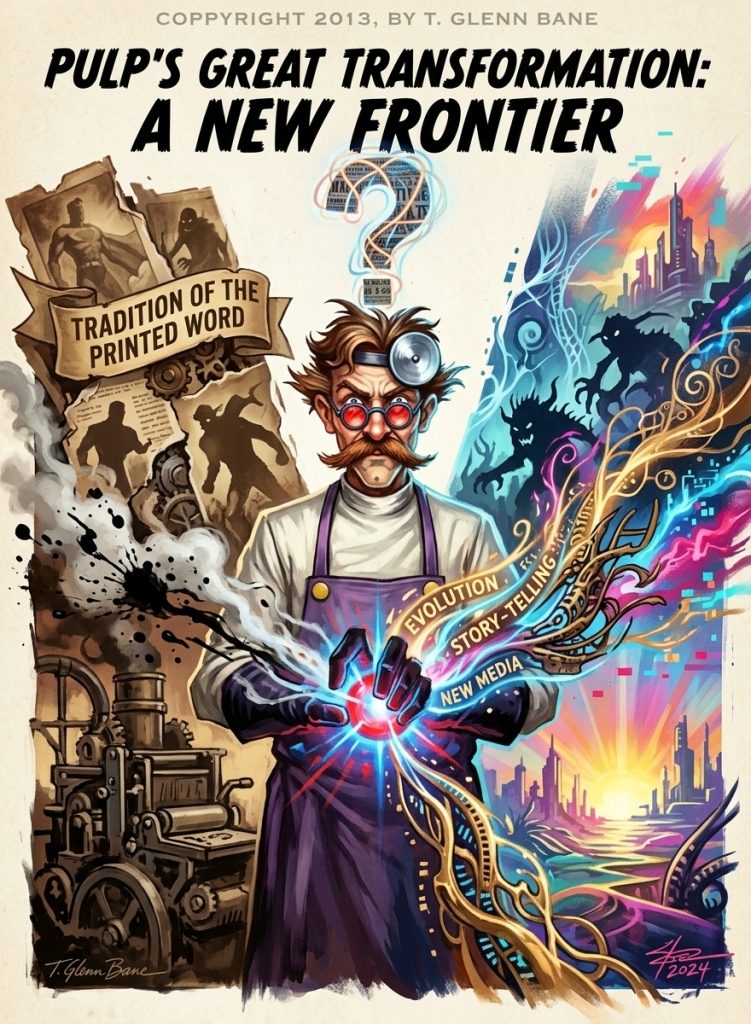
What Is Pulp, Really?
Gather close, my curious students of the lurid and the lightning-struck. Pull up a crate, dust off the cobwebs, and let me set something straight before we go a single step further. There is a lie about pulp, whispered so often that many have come to believe it. The lie is this: that pulp is a look. A style of yellowed paper and garish covers, a costume you can slip on and parade about in. No. A thousand times, no.
Let me tell you what pulp truly is. And I promise you this — by the end, you will never again mistake the clothing for the living thing beneath.
Pulp Is Not a Costume
Hear me plainly, for this is the hinge on which everything turns. Pulp is not nostalgia. It is not a retro aesthetic. It is not a trunk of old hats and trench coats you dust off for a weekend of pretend.
To boil pulp down to a look is to mistake the ash for the fire. You can paint a cover in faded sepia, scuff the edges, and ape every visual trick of the old masters — and still produce something utterly dead. Why? Because pulp was never about how a thing appeared. It was about the roaring human engine underneath: the unbridled ambition of writers racing to capture a world changing faster than anyone could comprehend.
Do not confuse that raw creative hunger with modern cosplay. One is a costume. The other is a storm.
It Was Born of Real Terror
Let us return to the 1930s, and let us go there as scholars, not tourists. What made the pulps crackle was not clever paper. It was fear — genuine, bone-deep fear of a world being remade in real time.
Consider the anxieties of that age, laid out in order:
- Rapid urbanization herded strangers together in towering cities, dissolving the old comforts of distance and familiarity.
- The telephone collapsed space itself, letting a voice travel miles in an instant — a marvel that felt, to many, like sorcery.
- The small press placed the power of the printed word into local hands, democratizing storytelling for the common person.
- Electricity dislodged superstition and witchcraft, flooding ordinary homes with wonders that had belonged, only yesterday, to gods and ghosts.
These changes dazzled some and terrified others. Countless souls could not see where it was all heading or how it would end. That terror — that vertigo of standing at the edge of an unknown future — poured straight into the pulps. The detective, the adventurer, the mad scientist, the monster from below: these were not mere decorations. They were the shapes that era gave to its deepest unease.
The Archetypes Belonged to Their Age
Here is where the careless reader stumbles. They look at the hard-boiled detective and the jungle hero and say, “There — that is pulp.” But those archetypes were answers to questions the 1930s was asking. They were products of that era’s specific anxieties and specific wonders.
So let me pose the question that matters: if the familiar faces of the 1930s rose from the fears of the 1930s, why on earth would they be the faces of today?
They may not be. They should not be, if we are honest about the craft. The archetypes of yesterday reflected telephones and tenements and the electric light. Today’s pulp must reflect today’s terrors and today’s marvels — or it is merely cosplay wearing a borrowed face.
Fast Forward to Our Own Frontier
Now cast your eyes to the present, and tell me if it does not feel terrifyingly familiar.
Enter the new marvels. The internet, collapsing distance far beyond anything the telephone dared. Artificial intelligence, dislodging our certainties about thought and creativity the way electricity once dislodged superstition. Biotechnology, as we crack open the human genome and reach into the very blueprint of life itself.
These wonders dazzle some and terrify others. Many cannot see where it is all heading or how it will end. Does that echo ring a bell, my students? It should. We are living through our own pulp moment, standing at the same dizzying edge our forebears stood upon a century ago.
So I ask you the twin questions that ought to haunt every storyteller working today:
Who was the futurist then? And who is the futurist now?
Pulp Is the Grandfather of It All
Let us settle the matter of pedigree, for it is often forgotten. Yes, there were masters of the written craft long before the pulp storm swept through. Giants walked the earth before the dime magazines ever rolled off the press. I will not pretend otherwise.
But here is the truth no honest writer can dodge: there is no one working today who has not been touched by pulp. It is the literal grandfather of every form of modern fiction we have. The thriller, the mystery, science fiction, fantasy, horror, the superhero, the space opera — trace their bloodlines back far enough and they all return to that roaring, cheap-papered, ambition-soaked source.
You may write in any genre you please. Pulp is already in your veins.
Where Does Pulp Stand Today?
So we arrive at the questions that stir my old bones, and I leave them with you deliberately unanswered — for they are yours to wrestle with now.
Where does pulp stand today? What becomes of that roaring energy in an age of screens and algorithms and spliced genomes? If the old archetypes belonged to the old fears, what new shapes must we forge for the fears and wonders rising all around us? Who will be the futurist of this age, giving terrible and glorious form to the uncertainties no map has yet charted?
What, in short, is the future of pulp?
At Scaldcrow Games, this is precisely the frontier we love best — not reenacting the past, but seizing the living force at its heart and dragging it boldly into territory no one has charted. Pulp was never a costume. It was always a storm. And the storm, my curious caretakers, is only gathering strength.
Come build the new pulp with us. The future is uncertain, terrifying, and absolutely glorious — and it has a seat saved just for you.
Boldly Forward,
T. Glenn Bane
Want more Gamer? Look no further! Check out our other articles in our blog’s ARTICLE INDEX.