
Mazes & Mondays: Heroes are a Fool’s Debt
Strange Perspectives, Part 3 of 4: Why Every Hero in Sundrah Needs Better Life Insurance (Humorous)
The Dark Fantasy of Sundrah is anything before humor…and that’s what demands it.
I learned the most important rule of adventuring economics around thirty years back, watching a tavern owner cry into his ledger.
Never loan money to a hero. They never pay it back. Not because they’re crooks—because they’re dead.
This particular fellow ran a warm little taproom and extended credit to a party that swore up and down they’d return with treasure. They’d settle the tab. They’d be back inside a week, gold jingling, mugs raised in his honor.
Three of them were eaten by something living under an abandoned temple. One was turned into a tree. The last wandered off into the wilds after a failed save and was never seen again.
The tavern owner nailed their unpaid bill to the wall as a memorial. Years later, that yellowed scrap of parchment was still hanging there, gathering smoke. My players thought it was the funniest thing they’d ever seen.
The tavern owner did not.
And he’s not alone in that particular misery.
More recently, I’ve watched merchants hire adventuring parties to retrieve relics—specific items, clearly described, with coin and reputation on the table as payment. The parties accepted. They went out. They completed the job. They retrieved what was asked.
And then they never came back.
No delivery. No payment collected. They simply caught the scent of the next adventure and wandered off toward it, leaving the merchant standing in his doorway, empty-handed, again and again.
Which brings me to the second rule of adventuring economics:
Never hire a hero to bring something back. The adventure will distract them before the errand does.
Sundrah Is Not the Most Dangerous Setting. It’s the Worst.
There’s a difference, and it matters.
In most worlds, danger at least plays fair. A dragon is a dragon. A giant is a giant. Poke either with a sword and you’ve signed the contract with your eyes open. The risk is honest.
Sundrah is not honest. Sundrah keeps inventing fresh new ways to ruin your afternoon.
Consider the Doomgate. Most people spend their whole lives trying not to die. In Sundrah, death is often where the trouble starts. The Doomgate is the dark realm of the Rune Gods, the destination for souls their influence has claimed. Dying wrong doesn’t end the story. It hands the ending to your enemies.
Try explaining that to a fresh recruit.
“Good news—you survived the undead, the cultists, and the giant spider.”
“Wonderful.”
“Bad news—death is still very much on the table. And it might not be the peaceful kind.”
Suddenly, farming looks like a growth industry.
The People Who Understand Risk
The older I get, the more I admire sensible trades. The blacksmith, the carpenter, the miller. These are people who respect danger. They know a hot forge from a cold one and never test the difference with their face.
Adventurers understand nothing of the sort.
An adventurer sees a crumbling fortress carved with cursed sigils and walks toward it. No caution. No hesitation. Ruins pull heroes the way a lantern pulls moths, and with much the same result. A sane person reads a warning. A hero reads an invitation.
That’s precisely why so many ruins in Sundrah stay occupied. The monsters don’t have to hunt. They simply wait by the door, because they know exactly who’s coming and roughly when.
I had one player who nearly broke my brain by doing something I hadn’t prepared for.
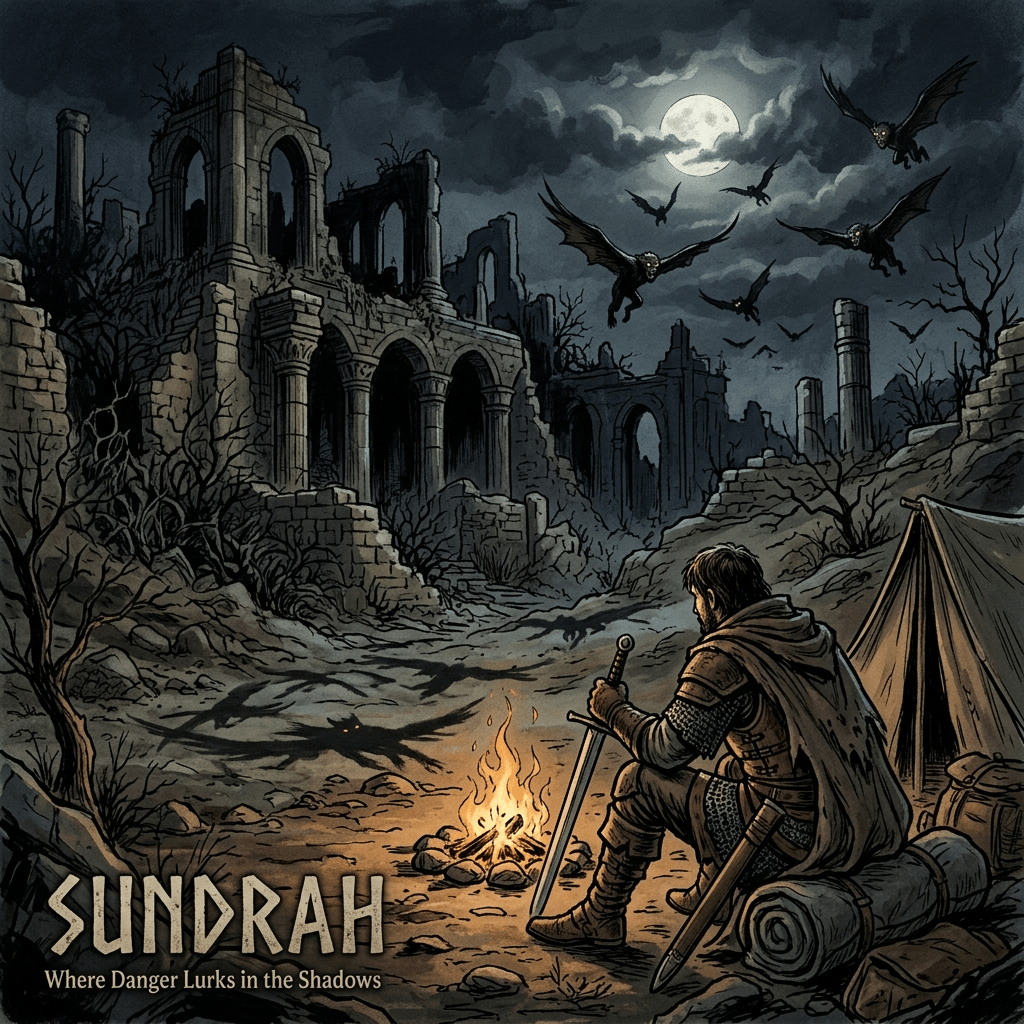
His warrior was traveling alone through a desolate stretch of country when he camped near a decrepit ruin. I was already rubbing my hands together. Then he just… didn’t go in. He made his fire, set his bedroll, and ignored it completely. Frustrated, I sent winged, carnivorous apes screaming out of the dark to attack his camp. He fought them off. He looked at the ruin. He said, out loud, at my table: “Nothing good can come out of a ruin in a desolate wasteland at night. Nope. Nothing.”
Then he went to sleep.
In the morning, he packed his things and continued his journey without a backward glance.
He was right. What lived in that ruin was not a cry for adventure. It was the eternal scream of death and damnation wearing the shape of an open door. He left it closed.
Which raises an uncomfortable question.
If a hero leaves the door closed—is he still a hero?
Maybe not. But he is certainly alive. And unlike the merchants waiting on relic deliveries that will never arrive, he at least knew what he was walking away from.
The Doomgate Survivor
One of my favorite archetypes in the whole setting is the Doomgate Survivor.
Sit with that title a moment. Not Explorer. Not Champion. Not Conqueror.
Survivor.
An entire class exists because someone crawled back out of a place no one was ever meant to leave. And even then, they don’t come back whole. They return haunted, altered, carrying scars no healer can touch.
That’s Sundrah to the bone. Victory here is never clean. The heroes win. They save the village. They break the cult. Then they spend the next decade explaining why they go quiet during thunderstorms and won’t sit with their back to a door.
When I was young, I thought heroes were extraordinary because they were brave. I’m no longer certain. I think they’re extraordinary because they possess an almost supernatural gift for ignoring the obvious.
The evidence is damning. A voice whispers from beneath the old ruins—the hero investigates. A book bound in suspicious leather starts talking—the hero opens it. A villager says everyone who enters those caves vanishes—the hero buys extra torches.
That’s not courage. That’s a diagnosable personality type. And I’d wager the Rune Gods have taken notice.
The World Makes Its Own Monsters
Not every threat wears a god’s face. Sundrah is perfectly capable of generating horrors on its own.
The Wyrgog want humanity swept aside and replaced. The undead refuse the simple courtesy of staying buried. The Dark Fey are convinced nearly every terrible idea deserves an enthusiastic second attempt.
And then there are cockatrices.
I’ve always had a soft spot for the cockatrice. Not because I’d care to meet one, but because somewhere, at some forgotten hour, a mind looked upon an ordinary chicken and thought: this needs more horror. The result turns a pleasant morning’s ride into a cautionary tale and a careless traveler into a very surprised statue.
Plenty of worlds boast dangerous monsters. Only Sundrah builds ones that sound ridiculous right up until the moment they kill you.
They Know. They Go Anyway.
Here’s the part that’s kept me at this table for thirty years.
The heroes know. They know the odds. They know most ancient artifacts are cursed, that every dark forest hides something with an appetite, that the mysterious stranger in the corner of the tavern will become a problem before last call. They know the merchant waiting on his relic will probably be left standing in that doorway.
And they go anyway.
That’s what I love. Not the glory. Not the loot. The flat refusal to let fear—or obligation, or common sense—make the decision for them. The next horizon will always outweigh the last promise. The next ruin will always whisper louder than the contract on the table.
Humanity endures in Sundrah for exactly this reason. Enough stubborn souls keep stepping forward when every scrap of reason screams to step back. The farmer does it. The merchant does it, even after the third party leaves him empty-handed. The soldier does it. The adventurer just does it in stranger, wetter, more haunted places.
But every now and then, somebody makes camp, fights off the winged horrors, looks at the open ruin, and walks away.
That doesn’t make them a hero. It makes them something rarer in Sundrah.
It makes them old.
Next Time in The Sundrah Survival Guide
Part Four: The Wyrgog Travel Guide — Why You Should Never Camp Near a Bone Totem
We’ll tour the Wyrgog camps, unpack their tribal customs, marvel at some truly catastrophic camping decisions, and learn to recognize the warning signs that you’re about to become the main course in someone else’s campfire story.
Until then, keep your tab paid and your torches dry.
T. Glenn Bane
Scaldcrow Games™ • Worlds of Pulp™
If you would like to revisit past articles, look no further than the Geek Opera Index!
Watch the shadows, my friends. And always check your ale for poison.