
Worlds & Wednesdays: From Spark to World
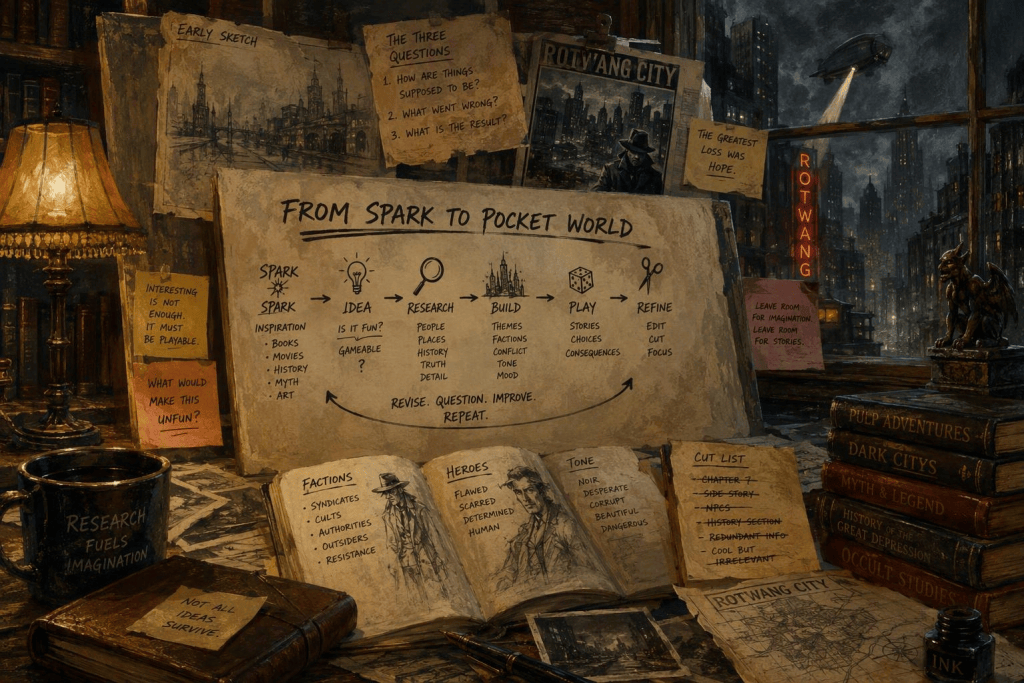
From Spark to Pocket World: How a Setting Is Born
Before I can explain how a Pocket World comes into existence, I should begin with what a Pocket World actually is.
A Pocket World is a snapshot. It is a location, an event, an organization, or a circumstance captured at a moment when interesting things are happening. More importantly, it is a foundation. Every Pocket World is designed to support stories that can expand beyond its borders and inspire campaigns far larger than the pages that contain it.
They are intentionally modular. A Game Moderator can connect them however inspiration demands. A book such as AJAX, Häxanburg, or The Tea Factory can serve as a bridge between worlds that might otherwise seem impossibly distant from one another. Meanwhile, settings such as Black Dogs and SIG may feel much closer in geography and theme, making the transition even easier.
I build them this way because I have always preferred settings that leave room for imagination. Growing up, I often found myself disappointed when I reached the hard edge of a fictional world and discovered there was nothing beyond it. The most inspiring settings are not those that define every detail. They are the ones that leave a few corners unexplored.
A setting should feel lived in, not completed.
If every answer is already provided, then the players are simply borrowing someone else’s toys. They can still have fun, certainly, but only within prescribed boundaries. Freedom is one of the great engines of creativity, and I never want a setting to suffocate it.
Where Ideas Come From
Every Pocket World begins the same way: with a spark.
That spark can come from almost anywhere. It might emerge from a novel I am reading, a film I watched twenty years ago, an old myth, a painting, a historical event, or a stray thought that refuses to leave me alone.
The source is not what matters.
What matters is the question that follows.
Is this fun?
That sounds simplistic, but it is the single most important question in the entire process.
Many ideas are interesting. Far fewer are gameable.
An interesting idea may be intellectually engaging, but a gameable idea invites action. It offers players meaningful decisions. It creates opportunities for conflict, adventure, mystery, triumph, and failure.
At the same time, I ask the opposite question:
What would make this setting unfun?
I do not want players imprisoned by a premise. I want them empowered by it.
Once I start seeing possibilities, I begin connecting the concept to the traditions of pulp storytelling. Every Pocket World is ultimately filtered through a pulp lens. Whether the theme leans toward adventure, horror, mystery, science fiction, noir, or fantasy, I want to understand how that genre feels before I ever attempt to write it.
A setting is more than geography.
A setting is mood.
It is atmosphere.
It is emotional presence.
If a player finishes reading one of my books and understands the facts but not the feeling, then I have not finished my job.
The Development Stage: Rotwang City
One of the clearest examples of this process is Rotwang City.
Once the basic concept felt strong enough to pursue, I moved into my favorite stage of development:
Research.
Research is where a rough idea begins transforming into a believable world.
For Rotwang City, I needed to understand what life actually felt like during the Great Depression. Not simply the economics. Not only the politics. I wanted to understand the human experience.
At first, the answers seemed obvious.
People needed money.
People needed food.
People needed shelter.
Simple enough.
But the deeper I researched, the more I realized those answers were only symptoms.
The real issue was hope.
Money sat at the center of everything, and for many people it had vanished. Once financial security disappeared, every other aspect of life became vulnerable. Families fractured. Communities weakened. Institutions struggled.
The question became larger than survival.
How did people preserve their dignity?
How did they maintain their morals?
How did they retain faith in one another?
The more I studied the era, the more I came to believe that the greatest loss was not material. It was hope itself.
Hope that things would improve.
Hope that the rules mattered.
Hope that authorities could be trusted.
Hope that tomorrow would be better than today.
That realization became the beating heart of Rotwang City.
Suddenly, the rise of organized crime made perfect sense. Criminal syndicates stepped into vacuums created by broken institutions. They provided order where governments had failed. They became shadow authorities.
The same logic explained the growth of cults, dark mysticism, and dangerous beliefs within the setting.
If desperate people would place their trust in mobsters, they might also embrace anything offering answers, even false ones.
After all, false hope is still hope.
Only after I understood that core truth did I begin writing.
Building the Heroes
Once the environment was established, the next question was obvious:
Who could possibly stand against all of this?
The heroes of Rotwang City are not pristine champions.
They are damaged people navigating a damaged world.
Many struggle with the same despair affecting everyone around them. Some carry scars. Some make questionable decisions. Some barely qualify as heroes at all.
Yet they continue fighting.
That tension became central to the setting.
The villains could be monstrous, corrupt, supernatural, or tragically misguided. The heroes often occupied the uncomfortable terrain between righteousness and survival.
That moral uncertainty eventually pushed the setting toward something unexpected.
Not merely pulp.
Pulp noir.
The Three Questions
When developing any Pocket World, I rely on three foundational questions:
- How are things supposed to be?
- What went wrong?
- What is the result?
Those three questions establish almost everything that matters.
They define the setting.
They define the conflict.
They define the tone.
Most importantly, they reveal where stories are likely to happen.
When an Idea Gets Abandoned
Not every concept survives development.
Some ideas reveal flaws once they are examined closely.
Sometimes the moral center of the setting becomes muddled. Sometimes the premise unintentionally suggests something I never meant to say. Sometimes a concept is fascinating in theory but offers little room for meaningful play.
When that happens, I force myself to ask difficult questions.
What am I really saying?
What does this project suggest about the world?
What responsibility do I have as its creator?
During the development of Rotwang City, these questions became particularly important because the setting touches on addiction, gambling, murder, corruption, suicide, social inequality, and numerous other difficult subjects.
Rather than abandon the project, I leaned harder into the noir elements and made those themes part of the setting’s identity. I made sure readers understood exactly what kind of stories the world was designed to tell.
Other projects are not so fortunate.
Recently, I shelved a Victorian-punk concept because it asked players to inhabit perspectives that felt too alien and unsympathetic. The individual ideas interested me, but together they created barriers instead of opportunities.
The project is not dead.
It simply resides in the slush pile.
Many abandoned ideas eventually return in new forms, carrying lessons learned from earlier failures.
Learning to Cut
One of the most important lessons a designer can learn is not to fall in love with a project.
Enjoy it.
Believe in it.
Work hard on it.
But never become incapable of criticizing it.
The most dangerous words a creator can say are:
“I can’t remove that part because I like it too much.”
Editing exists to serve the project, not the author’s ego.
By the time a Pocket World reaches its final draft, significant portions may already be gone. Entire chapters have disappeared from my books. Some contained writing I was genuinely proud of. Some represented weeks of effort.
None of that mattered.
If the material failed to strengthen the Pocket World, it had to go.
A beautiful chapter that weakens the setting is still a weak chapter.
Sometimes cuts happen because a concept belongs elsewhere. Sometimes they happen because I finally recognize an idea I should have abandoned long ago. Other times they happen for practical reasons such as page count, production costs, or pricing considerations.
Regardless of the reason, the principle remains the same:
Every page must justify its existence.
If it does not support the setting, reinforce the theme, or expand opportunities for play, then it is occupying space that could be used for something better.
In the end, creating a Pocket World is less about building everything imaginable and more about discovering what deserves to remain.
The published book is not the collection of every idea I had.
It is what survived.
Want more Gamer? Look no further! Check out our other articles in our blog’s ARTICLE INDEX.