
Frights & Fables: The Reaper of the Rows
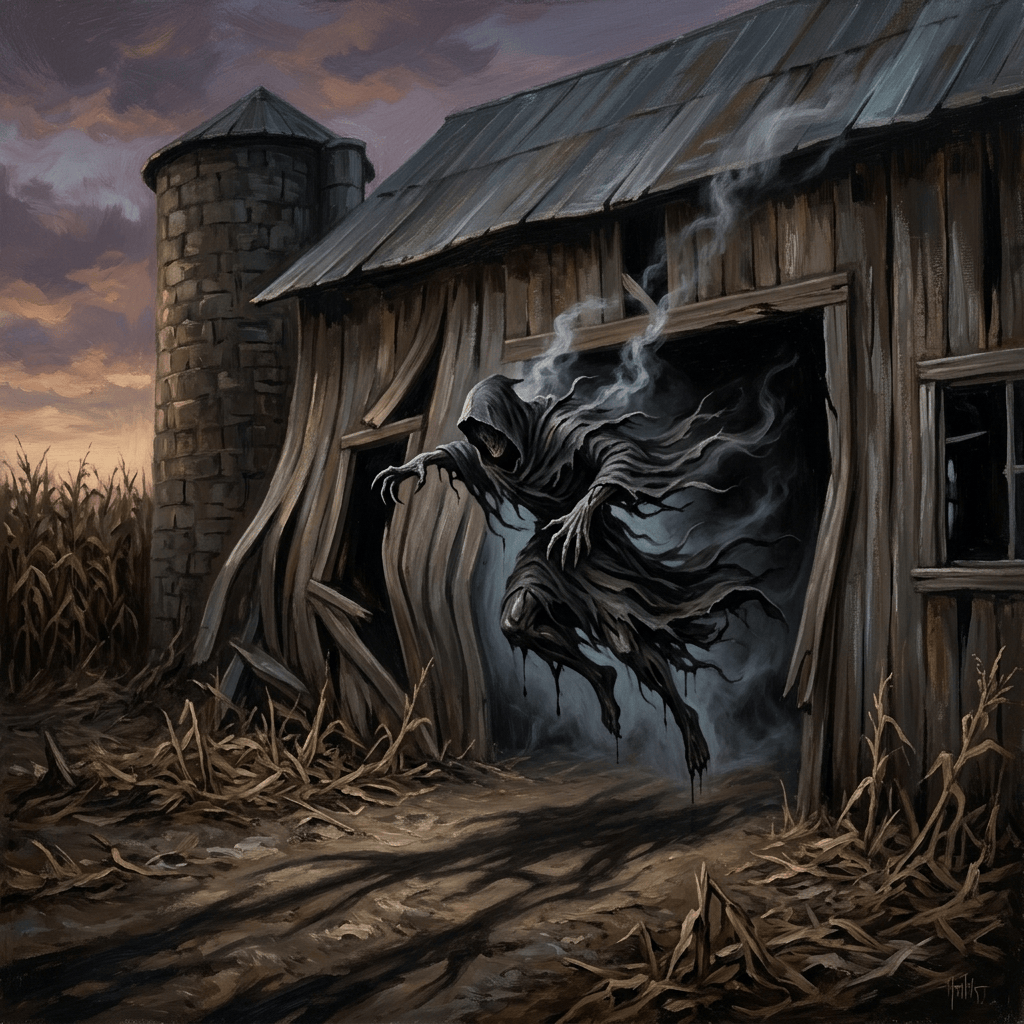
The Reaping at Hollow Furrow
A One-Night Monster of the Week Adventure for Worlds of Pulp™ — Skinny Pulp Heroic Rules
Ah. You’ve come back to the parlor. Good. Sit down, mind the harvest wreath on the door — it’s older than it looks, and hungrier. Tonight I have something small and vicious for you, my dears. A single evening’s terror, start to grave, built to run in about three hours and put to bed by midnight.
This is the sacred, silly art of the Monster of the Week. You remember the shape of it — that weekly ritual of dread, a fresh creature slouching across the screen like clockwork, like a curse. The story rarely changed. The bones stayed reliably the same. But the beast? The beast was always new. Popcorn that bit back.
We’re going to bottle that giddy, disposable delight and pour it onto your table. No thick tomes. No sprawling campaign. Just a desperate little farm town, a monster that never should have been called, and a night that ends in blood or dawn — whichever comes first.
Scaldcrow Games built the Skinny Pulp engine for exactly this: lean rules, fast pulp, and a Game Moderator who can conjure horror on a Friday. So let’s roll up our sleeves and carve this beast open.
A Note on Your Home System
Before we begin, a small kindness. This adventure wears Worlds of Pulp™ clothing, but the skeleton underneath fits nearly any system you already love. The four bones of a Monster of the Week — origin, invitation, hunting ground, and final confrontation — are system-agnostic to their marrow.
Swap the stat blocks for your own. Trade the ability scores for whatever dice and modifiers your table prefers. The Reaper’s real teeth aren’t its numbers — they’re its tricks: the warping space, the impossible bounds, the fact that it cannot truly die until the door is spoken shut. Keep those, and the horror travels wherever you take it.
The Anatomy of a Beast
Before we build our machine of misery, we perform the autopsy. Peel back the skin, and you’ll find four bones.
Where it came from — Something summoned by a desperate, dabbling hand.
How it got here — Someone invited it, knowingly or not.
The hunting ground — A small farming community, swollen with harvest and now cut off by flood.
The final confrontation — A trap, sprung at the perfect and terrible moment.
That’s the frame. Now let’s hang the horror on it.
The Pitch (Read to Your Players)
The harvest is late in Hollow Furrow, and the fields have gone quiet. Too quiet. A farmer’s boy went missing three nights back. Then a whole family. The county road washes out with the first hard rain, and the only bridge is under six feet of angry water. You are here now — and here is where you’ll stay until dawn or until it’s over. Whichever comes first.
That’s your closed stage, darlings. A flood-washed bridge, one road out, and it’s gone. No cavalry. Your heroes survive until sunrise, or they don’t survive at all. Horror lives where hope hangs by a thread — so give them the sunrise to run toward, and nothing else.
Why Your Heroes Are Here
Give each character a thread. It takes thirty seconds and it buys you three hours. Since this is a drop-in romp, let your players pick from these generic hooks and bend them to whatever hero they’re bringing to the table:
- The Insurance Claim. Your hero works for a rural coverage firm — or knows someone who does. A Hollow Furrow farmer filed a claim last month for a destroyed crop: no blight, no storm damage, no explanation. The county adjuster sent to investigate never filed his report. Your hero came to find out why.
- The Missing Deputy. The county sheriff’s office sent a deputy to Hollow Furrow six days ago after reports of missing livestock and a dead farm hand. The deputy stopped radioing in on day two. Your hero — a colleague, a relative, or someone who owes that deputy a debt — came to find them.
- The Academic Trail. Your hero has been tracking Professor Emmett Coyle for weeks — a researcher who vanished from his university post under strange circumstances and drained his savings account the same day. The trail ends in Hollow Furrow, and so does the road.
- The Newspaper Tip. An anonymous source mailed your hero a clipping: a two-inch notice buried in the regional farm report about a Hollow Furrow harvest that failed without cause. No byline. No return address. Someone wanted this seen. Your hero came to find out who sent it — and why they were afraid to sign their name.
- The Unpaid Debt. A Hollow Furrow farmer — now unreachable — lent your hero money during a hard season and never asked for it back. Your hero drove out to settle the account. The farm is empty. The fields are wrong. And the bridge is gone.
- The Warning Dream. Your hero doesn’t scare easy and doesn’t put stock in visions — but the same dream, three nights running, is hard to ignore: a field of steaming corn, a door with no frame, and a voice speaking Latin in the dark. They came to Hollow Furrow to prove there’s nothing here. They were wrong.
Any of these lands a hero in town with a reason to care and no way to leave. That’s all you need.
The Drop-In: Harold David Paine
Give this fellow to a player, or run him as a desperate NPC who becomes a lifeline — and a liability. Either way, he’s the beating, guilty heart of this story.
Bio
Harold David Paine is a soft-spoken agricultural inspector from the county seat, forty-six years old, with three failed careers behind him and a fourth that’s fraying at the edges. Before the clipboard and the county badge, he was a seminary dropout, then a traveling patent-medicine man, then a bookkeeper for a man who turned out to be far worse than a swindler. Harold has a lifelong nose for things that don’t add up — ledgers, harvests, and men.
He came to Hollow Furrow three weeks ago to investigate a crop failure that made no sense. What he found instead was Professor Emmett Coyle, a nervous academic renting the old Marsh place, burning strange lamps at odd hours and buying up every scrap of livestock in the county. Harold started asking questions. Harold started keeping notes. And Harold, God help him, started believing what the notes were telling him.
He is not a fighter. He is a witness — the man who watched the desperate hand that dabbled, and did nothing until it was too late. Guilt sits on him like a wet coat. He wants to make it right, and he’s terrified that “right” is going to cost him everything.
The GM’s secret: Harold helped the professor. Not knowingly, not at first — he translated a page of the professor’s notes as a favor, a bit of dog-Latin he half-remembered from seminary. That translation was the final line of the summoning. Harold is the one who “invited it, knowingly or not.” He doesn’t know this yet. He’ll learn it at the worst possible moment.
Description
A stooped, careful man with thinning sand-colored hair combed hard across a freckled scalp. Wire spectacles, always smudged. He wears a rumpled brown suit gone shiny at the elbows and carries a leather satchel stuffed with papers, pencils, and one small tarnished crucifix he no longer admits to owning. His hands shake — have for years — and he covers it by keeping them busy: adjusting his glasses, straightening his tie, turning a pencil over and over. When he’s frightened, and he’s frightened often, his voice drops to a near-whisper, as though he’s afraid the walls are grading him.
Roleplay him as decent, weary, and quietly brave in exactly the wrong moments.
Stat Block
Agility: 5
Combat: 4
Intelligence: 7
Magnitude: 5
Might: 5
Perception: 7
Toughness: 5
Willpower: 6
X-Factor: 5
Hits: 8
Movement: 9mph (18′)
Box Car Points: 6
Cash: 6
Conditions
- Foolish (poor emotional judgement): 8
- Guilty Nature: 5
- Sophisticated (refined upbringing): 7
- Suspicious (questions motives): 7
- Temperamental (emotional volatility): 8
Abilities
- Agricultural Inspector: 5
- Calming Presence: 5
- Driving: 5
- Latin and Languages: 6
- Procedures (professional methods): 7
- Record Keeping: 5
- Song and Performance: 6
- Streetwise (Knows-the-Score): 5
Starting Equipment
Rumpled brown suit, long wool overcoat, scuffed dress shoes, wire-rim spectacles. Leather satchel, county inspector’s badge and identification papers. Notebook stuffed with observations and translated notes, Professor Coyle’s copied ritual notes, pencils and fountain pen, bus ticket stub. Pocket flashlight, folded county road map, thermos of coffee. Small tarnished crucifix, pocket watch, handkerchief, box of matches, small folding penknife.
The Beast: What Slouched Into Hollow Furrow
Now, the star of our little production. Let’s do the autopsy, my dears. Four bones.
Where it came from — A desperate, dabbling hand. Professor Emmett Coyle lost his wife and daughter to fever last spring, and grief drove a bright man into black study. He found a rite he shouldn’t have. He wanted to call something that could give the dead back. He got something else entirely.
How it got here — Someone invited it. Coyle spoke the words, yes, but the summoning needed a second voice to seal it — and Harold Paine, doing an old man a kindness, translated the final line aloud. The door opened. Neither of them understood what they’d done.
The hunting ground — Hollow Furrow, a small farming community swollen with harvest and now cut off by flood. Silos, barns, a church, a general store, fields of tall dead corn perfect for stalking. The town itself has teeth.
The final confrontation — A trap, sprung at the perfect and terrible moment.
The Reaper of the Rows
Do not name it for your players. Names make monsters manageable, and this one should stay a mystery as long as you can hold it.
It came in the shape of hunger. It has no face your heroes will agree on afterward — one saw a bent scarecrow, one saw a thing of wet ribs and steam, one saw nothing at all until it was already on them. Its identity is horror; its silhouette is memory’s guess.
How it attacks — It spits. A spray of scalding, acidic bile that hisses on skin and eats through cloth, wood, and cheap tin. Describe the sound first — a wet hitch, like a kettle drawing breath — then the burn.
How it moves — In sudden, impossible bounds. It doesn’t run. It’s fifty feet away in the corn, and then it’s not. Never let players feel they can outrun it. They can only outthink it.
What it looks like — Skin that drips and steams, sloughing in the cold night air, always wet, always smoking faintly like a thing pulled fresh from something hot.
Its terrible gift — It bends the space around it. Halls stretch. A door you came through is now a wall. The barn you’re running toward is suddenly behind you. When the Reaper is near, geometry becomes its weapon — and its ambush. It waits inside the folds of a warped room, then unspools the space and is simply there, mid-leap, bile already rising. Use this sparingly and cruelly.
A note on its weakness (for the GM): It was called through a spoken door, and a spoken door can be spoken shut. Harold’s crucifix and the professor’s original notes together hold the counter-rite. A hero with psychic or occult gifts can read the summoning’s structure if they get close to the source. This is the puzzle at the story’s heart — the trap that saves them is the same trap that could damn them.
Creature Stat Block
Type: Non-human — summoned entity (extraplanar predator)
Core Abilities
- Combat: 10+3
- Agility: 10+5
- Might: 10+2
- Willpower: 10+4
- X-Factor: 10+8
- Magnitude: 10+6
- Toughness: 10+2
- Intelligence: 7
- Perception: 10+4
Hits: (Willpower 14 + Magnitude 16 + Toughness 12) – 8 = 34
Note: When reduced to 0 Hits, the Reaper folds into its own warped space and returns at full Hits (34). It cannot be permanently destroyed this way. Only closing the summoning door — the spoken counter-rite — ends it for good.
Conditions
- Deceptive (lures prey through false paths): 9
- Insatiable (hunger never satisfied): 10
- Patient (stalks before striking): 8
- Possessive (claims its hunting ground): 8
- Relentless (never abandons a target): 9
- Remorseless (incapable of mercy): 10
- Territorial (guards the warped space): 8
Abilities
- Ambush Predator: 10+6
- Bile Spray (scalding, acidic): 10+3
- Impossible Bounds (sudden leaps): 10+5
- Regeneration (returns at full Hits): 10+8
- Silent Stalking: 10+4
- Space-Warping (bends geometry): 10+8
- Terror Aura: 10+2
- Tracking by Scent: 9
Description
Steaming, dripping skin that never settles into one shape — witnesses swear it wore ribs, then a bent scarecrow, then nothing at all. No fixed eyes, no fixed face. It smokes faintly in cold air, wet as a thing pulled fresh from something hot, always seen from a wrong angle.
Backstory
Grief opened the door. Professor Emmett Coyle, hollowed by fever that stole his wife and daughter, chased a rite meant to call the dead back home. He spoke the words. But a summoning needs a second voice to seal it, and Harold Paine — meaning only kindness — read the final line of dog-Latin aloud. The door swung wide.
What answered was never human, never dead, never anything Coyle wanted. It came in the shape of hunger, slipping into Hollow Furrow through folded space no eye can trace. It does not belong here, and it knows it. That wrongness is its weapon — it bends halls, loops corridors, and turns cornrows into a maze of its own making. Kill it, and it simply steps sideways into the geometry and returns whole. The only end is the door itself, spoken shut.
Running the Night: Scene Structure and Pacing
Three hours, my dears. Keep it moving. Start with a bang, end with a bang, and never let the middle sag. Use the rhythm of dread and release — don’t spring the beast all at once. Let unease swell, then break, then swell again, higher each time.
Act One — Arrival (about 45 minutes)
Scene 1: The Bridge Is Gone. Open in the storm. The heroes converge on the washed-out bridge and are forced to meet. Establish immediately that there’s no way out. A body floats past in the floodwater — the professor’s landscaper, skin faintly steaming even in the cold rain. First taste of dread. Start here, in the action.
Scene 2: The Town That Locked Its Doors. Hollow Furrow is buttoned up tight. Shutters nailed. A frightened few gather in the church. Introduce Harold Paine, wringing his hands, desperate to talk to someone who’ll believe him. He knows about the professor. He doesn’t yet know his own part in it.
NPC Notes:
- Pastor Odell Grim — Old, stubborn, praying over a problem that won’t be prayed away. Useful for exposition and a sacrificial scare.
- Ruth Kessler — A farm widow who lost her boy first. Grief-hard and sharp; she’ll point fingers at the professor before anyone else.
- The Doubter — Every town has one. He thinks it’s wolves, or drifters, and his refusal to believe gets someone killed in Act Two.
Act Two — The Hunt (about 90 minutes)
This is your dread-and-release engine. Layer it. Deny easy answers as the heroes move toward the truth.
Scene 3: Signs in the Corn. Send the heroes into the fields or out to a neighboring farm. Warning signs — melted fence wire, a barn door dissolved at the hinges, tracks that leap forty feet between prints. Build unease. No monster yet.
Scene 4: The First Reckoning. The Reaper strikes — but not at the heroes. It takes the Doubter, or a bystander the players were trying to protect. Show its power: the bile, the impossible leap, the steam, the way it appears out of a warped doorway. Then it’s gone. This is your first release after the swell.
Scene 5: The Professor’s House. The old Marsh place. Here the players find Emmett Coyle — half-mad, guilt-eaten, still trying to “finish the work” and get his family back. He can give them the shape of the counter-rite but not the courage to use it. A hero with occult senses can read the summoning here. And here Harold, hearing the professor recite the Latin, recognizes his own translation — the horrible dawning that he opened the door.
Use the space-bending. The house should betray them. Rooms rearrange. The way out becomes the way deeper in.
Act Three — The Trap (about 45 minutes)
Scene 6: Setting the Snare. The heroes know what they need — the crucifix, the notes, the spoken counter-rite, and a way to hold the Reaper still long enough to shut the door. The trap must be built and baited at night, in a place with one perfect terrible moment. Suggested stage: the grain silo, the church, or a corn maze the town cut for the cancelled festival.
Scene 7: The Perfect and Terrible Moment. Spring it. The bait draws the Reaper in — and here’s your gut-punch: the counter-rite needs a voice to close what a voice opened. It should be Harold. The man who invited it must be the one to speak it shut, and doing so may cost him. Let the players fight to protect him while the space folds around them, bile spraying, the beast leaping through warped geometry. Give them one round where everything goes wrong. Then let their plan land.
Scene 8: The Cost. Count your survivors. In Skinny Pulp heroic play, victory isn’t just breathing — it’s the townsfolk saved, the children pulled from the corn, the ones the heroes couldn’t reach. Measure the win in the living.
The Last Scare
End by exposing the truth — Harold’s guilt, the professor’s grief, the whole sad wanting that opened the door. Let the heroes have their dawn.
And then, as the flood recedes and the first cart rolls into town at sunrise, let one of them notice the corn at the field’s far edge. A single row still steaming, faintly, in the cold morning light. Something the door didn’t quite close.
Because the beast is never truly gone. Not in a good one-off. It only waits for the next harvest.
There’s your evening, start to grave. A closed town, a dabbling hand, a man who must unsay his own worst mistake, and a monster that folds the world around its hunger. Set the table. Dim the lamps. Let the corn whisper.
At Scaldcrow Games, we believe the best terror fits in a single night. So light your candle, deal your cards, and run it this weekend.
The greatest stories are the ones not yet told. Tell yours.
Breathe child. That’s right. There are more macabre revelations to come, but in the meantime, lean into our blog index and enjoy past perilous presentations. GeekOpera Index.