
Worlds & Wednesday: Yes and No in Editing
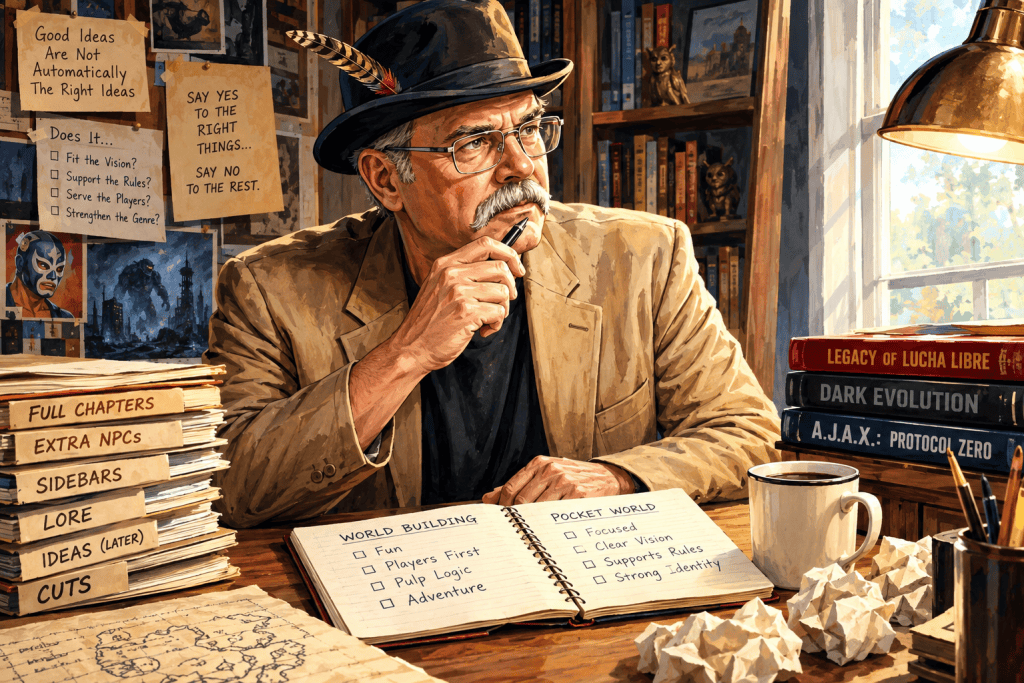
Creative Restraint: Why Good Worldbuilding Begins with “No”
One of the great misconceptions about creativity is that the challenge is coming up with ideas. For me, that has never been the hard part. Ideas arrive constantly. One concept leads to another, then another, until an entire web of characters, factions, locations, rules, and backstory threatens to grow beyond all reason.
The difficult part is not creating.
The difficult part is stopping.
Worldbuilding, especially for tabletop games, requires restraint. Every setting can become larger. Every book can become longer. Every chapter can gain another sidebar, another NPC, another piece of lore explaining why something exists. Left unchecked, creativity becomes its own form of bloat.
Over time I have learned that designing a setting is as much about saying no as it is about saying yes.
A good idea is not automatically the right idea.
The Questions That Guide the Knife
One of the hardest lessons I have learned as a publisher is that every idea cannot survive the editing process.
That does not mean those ideas are bad. In fact, some of the ideas I remove are ideas I genuinely love. The problem is not whether an idea has merit. The problem is whether it serves the project.
Whenever I work on a new Worlds of Pulp™ product, I evaluate material through two different lenses.
The first lens is the overall Worlds of Pulp philosophy.
- Is it fun?
- Does it put the players first?
- Does it allow room for pulp logic?
- Does it encourage adventure rather than restrict it?
Those questions apply to everything carrying the Worlds of Pulp name.
The second lens is more specific.
Does it fit the Pocket World?
Pocket Worlds are intentionally focused settings. They are designed to give players a strong identity and a clear vision rather than bury them beneath endless encyclopedic information. As a result, I examine every addition and ask:
- Does this make the vision clearer?
- Does it strengthen the core concept?
- Does it support the rules rather than distract from them?
- Does it reinforce how I want the setting to be experienced?
I rarely ask all of these questions at once. Instead, I read through a manuscript multiple times, each pass focused on a single concern. By isolating the question, I give it my full attention.
The result is usually surprising.
Things that seemed essential during writing suddenly become obvious candidates for removal.
Every Setting Has Its Own Identity
One reason restraint is important is that every Pocket World needs a distinct voice.
Take Legacy of Lucha Libre, for example. The setting is fundamentally optimistic. It celebrates heroic masked wrestlers, larger-than-life adventure, and the cultural traditions that inspired it. Throughout the design process I continually asked whether content supported that goal. The setting needed to remain fun, celebratory, and accessible while still embracing pulp adventure. Much of the city design, the archetypes, and even the adventure hooks were selected specifically because they reinforced those themes.
Dark Evolution, on the other hand, operates in completely different territory. The setting revolves around genetic horror, psychic awakening, government conspiracies, and difficult moral choices. The central question is repeated over and over:
What is a monster?
The setting works because it does not provide easy answers. Players must confront those questions themselves. The moment I become too eager to explain everything, the mystery begins to die.
Likewise, A.J.A.X.: Protocol Zero succeeds because it remains focused on science-action pulp: anomaly investigations, alien encounters, giant monsters, ethical dilemmas, and heroic response teams standing between humanity and the impossible.
If I allowed unwanted elements to spill across those boundaries, eventually all three settings would start feeling alike.
A setting without a strong identity becomes forgettable.
Restraint preserves identity.
The Battle Against Page Count
Another factor that shapes my design decisions is page count.
I like smaller books.
Part of that preference is practical. Smaller books are less expensive to produce and easier to carry. But there is another reason. Smaller books encourage focus.
My earliest projects often exceeded 200 pages. At the time I viewed every extra rule, paragraph, and lore entry as added value. Looking back, I realize some of that material actually diluted the experience. The books frequently contained information because I could include it rather than because I should.
Experience taught me something important.
Practice does not make perfect.
Practice makes you sharper.
It teaches you what to cut.
It teaches you what readers actually need.
It teaches you when enough is enough.
Many of the strongest decisions I have made as a designer were deletions, not additions.
Entire Chapters Die So Better Books Can Live
There have been occasions when I removed entire sections from manuscripts.
Not paragraphs.
Not pages.
Entire chapters.
Sometimes those chapters were good.
Sometimes they contained material I personally enjoyed.
Sometimes they represented dozens of hours of work.
But if a chapter distracted from the vision, it had to go.
Characters face similar scrutiny.
It is incredibly easy to overcrowd a setting with NPCs. Every new character suggests relationships, rivalries, backstory, statistics, and plot hooks. Before long, a book can become saturated with personalities fighting for page space.
That is one reason I often rely on SLIC characters. A handful of concise, useful NPCs frequently serves the reader better than pages of fully detailed personalities. SLIC characters provide inspiration and utility without devouring valuable space. This approach can be seen throughout books like Dark Evolution, Legacy of Lucha Libre, and A.J.A.X.: Protocol Zero.
The goal is not to provide everything.
The goal is to provide what is needed.
Ideas That Didn’t Survive
Some cuts are particularly memorable.
During the development of Dark Evolution, I seriously considered adding a specialized skill structure tied directly to Ravenesque Science. The setting already references Professor Raven, genetic experimentation, psychic manipulation, and forbidden research. Additional mechanics seemed logical.
The problem was that those mechanics explained too much.
Part of the appeal of Dark Evolution comes from uncertainty. The players are supposed to wonder. The setting works best when some doors stay closed. By removing those specialized systems, I preserved mystery and prevented the game from becoming overly mechanical in areas that benefited from atmosphere.
That decision hurt.
It was still correct.
On the opposite end of the spectrum, I deliberately kept the movie watchlists found throughout the line. Whether examining horror inspirations in Dark Evolution or science-action influences in A.J.A.X., those lists provide a useful creative shorthand. They communicate genre quickly without requiring pages of explanation.
Sometimes the best worldbuilding tool is not another chapter.
Sometimes it is a recommendation.
Avoiding Narrative Drift
One of the greatest dangers in worldbuilding is narrative drift.
A.J.A.X. provides a good example.
That setting needed anomaly investigations, alien life forms, kaiju, archetypes, equipment, vehicles, and mission-focused play. Those elements support the core premise of the game.
What it did not need was a sprawling, detailed city setting with dozens of additional districts, local politics, historical timelines, and unrelated factions.
Could I have added those things?
Absolutely.
Would they have improved the game?
Probably not.
In fact, they likely would have pulled attention away from the very thing the setting is about.
Every project has ideas waiting outside the front door.
Part of design is knowing which ones to invite inside.
Nothing Is Truly Lost
The good news is that cut material rarely disappears forever.
Ideas that fail to fit one project often reappear somewhere else. A discarded archetype may become the seed of a future Pocket World. A removed location may find a home in another setting. Additional encounters, NPCs, and lore frequently become articles, blog posts, downloads, or free website content.
When I remove something, I am not declaring it worthless.
I am simply acknowledging that it belongs somewhere else.
And that may be the most important lesson creative restraint has taught me.
Saying no to an idea is not rejecting it.
It is choosing the right place for it to live.
Because in the end, the purpose of worldbuilding is not to include everything.
It is to create something focused, memorable, and fun.
Sometimes the strongest thing a creator can do is close the notebook, draw a line through a paragraph, and trust that the world is better because of what was left out.
In Earnest,
T. Glenn Bane
Want more Gamer? Look no further! Check out our other articles in our blog’s ARTICLE INDEX.