
Tactical Tuesdays: Run. Run. Run.
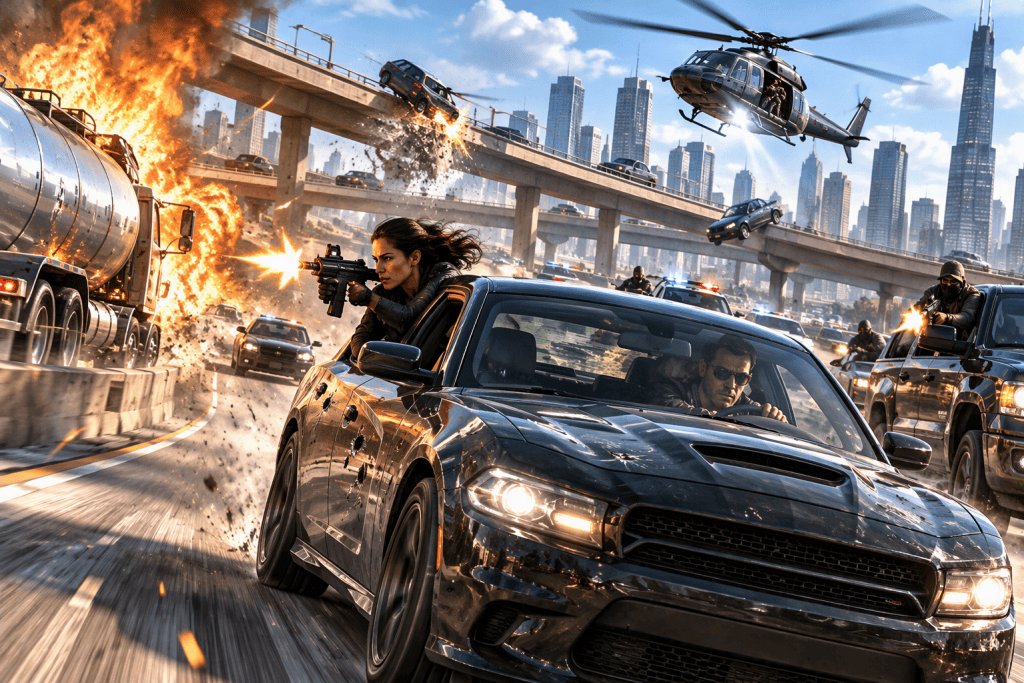
Tactical Tuesday: The Running Gun Battle
Motion, Chaos, and the Art of Fighting on the Move
The classic roleplaying firefight often resembles a medieval siege. Combatants dash to cover, settle into position, and exchange attacks until one side runs out of luck, ammunition, or hit points.
It works.
But it seldom captures the frantic energy of the great action stories.
Think about the most memorable firefights in cinema. John McClane doesn’t stay behind one desk. Judge Dredd doesn’t hold a single hallway. Jason Bourne, Ethan Hunt, and countless pulp heroes survive because they keep moving. The battlefield changes constantly. New threats emerge. Escape routes vanish. Every second brings fresh danger.
A running gun battle transforms a fight from a static exchange into a dynamic event. The battlefield becomes an active participant in the story. Characters relocate, pursue, retreat, maneuver, and improvise. The result is often one of the most exciting encounters a Game Master can put on the table.
Fighting While Relocating
Movement is life.
The moment characters stop moving, they become predictable. Predictable targets usually become casualties.
A running gun battle is built around constant relocation. The objective is not merely to win the fight. The objective is to win while reaching another destination.
That destination may be:
- A getaway vehicle
- An extraction point
- A hostage location
- A communications center
- A waiting helicopter
The key is giving players a reason to move.
Every round should present a new decision.
Do they cross the street under fire?
Do they take a dangerous shortcut?
Do they split up to move faster?
Do they stop and fight or continue toward the objective?
The more often those questions arise, the more cinematic the encounter becomes.
Bounding Overwatch
One of the simplest ways to make tactical movement feel realistic is through bounding overwatch.
The concept is straightforward.
One group moves while another group provides covering fire.
Then the roles reverse.
The first element reaches a new position, establishes security, and covers the second element as it advances.
This leapfrogging movement allows teams to advance without exposing everyone at once.
In game terms, bounding overwatch creates teamwork opportunities.
One player lays down covering fire.
Another rushes across open ground.
The sniper watches for emerging threats.
The tech specialist unlocks a security gate.
Every character contributes to the team’s survival.
The battlefield becomes a cooperative puzzle rather than a stationary shooting gallery.
Vehicle Support
Vehicles dramatically increase the scale of a running battle.
Suddenly the action is no longer limited to sidewalks and alleyways.
The fight can surge across entire districts.
A vehicle can serve multiple tactical roles:
- Mobile cover
- Heavy weapons platform
- Transport
- Escape route
- Diversion
The presence of vehicles introduces new complications as well.
A damaged engine may strand the heroes.
A crashed truck may block the only escape route.
A pursuing armored vehicle may force players into a risky detour.
The best vehicle encounters feel unpredictable. The players may begin the scene riding in a van and finish it hanging from a collapsing overpass.
That’s pulp adventure at its best.
Suppressive Fire
Action movies often depict suppressive fire as endless streams of bullets.
The reality, and the gaming value, lies elsewhere.
Suppressive fire isn’t about hitting the enemy.
It’s about controlling the enemy’s decisions.
Characters under heavy fire frequently choose survival over aggression.
Even villains become cautious when rounds are chewing through walls around them.
In roleplaying games, suppressive fire should create opportunity.
A heavy weapons specialist may not eliminate opponents outright, but that specialist can force enemies behind cover while the rest of the team advances.
This creates movement.
And movement creates drama.
The purpose of a running gun battle is not simply defeating opponents.
The purpose is forcing everyone on the battlefield to react.
Pursuit Versus Escape
Many of the greatest action sequences are not battles of destruction.
They’re battles of distance.
Someone is trying to get away.
Someone else is trying to stop that from happening.
The runner has advantages.
The pursuer has advantages.
Neither side controls the situation completely.
A pursuit may involve:
- Narrow streets
- Traffic congestion
- Sewer tunnels
- Elevated railways
- Industrial districts
- Rooftops
Every obstacle becomes part of the encounter.
Every choice carries consequences.
The heroes may catch their target but stumble into an ambush.
The villain may escape while leaving behind valuable intelligence.
Sometimes survival becomes more important than victory.
Those situations create memorable stories.
Tactical Set Piece:
The Freeway Gauntlet
“Three miles of asphalt. Hundreds of vehicles. One impossible mission.”
The Freeway Gauntlet is a running battle designed for urban heroes, espionage agents, and near-future operatives.
The encounter begins when the heroes acquire something valuable.
Perhaps it is a briefcase.
Perhaps it is a witness.
Perhaps it is a prototype weapon nobody should possess.
What matters is that everyone wants it.
The heroes find themselves trapped on a crowded freeway during peak traffic.
The battle begins immediately.
Phase One: The Pursuit
Enemy vehicles appear from multiple directions.
The heroes must navigate heavy traffic while avoiding attacks.
Possible threats include:
- Armed motorcycles
- Fast pursuit cars
- Unmarked vans
- Autonomous drones
- Jet-powered bikes in futuristic settings
The goal is simple.
Stay ahead.
Unfortunately, simple does not mean easy.
Phase Two: The Overpasses
As the chase intensifies, the freeway enters a dense urban corridor.
Overpasses cross overhead every few hundred yards.
Suddenly danger arrives from above.
Enemy shooters take positions on overpasses.
Explosives may be dropped onto traffic below.
Snipers may cover critical sections of roadway.
The heroes now face threats in two dimensions.
The ground war becomes a vertical battlefield.
Phase Three: The Fuel Tankers
Nothing says action cinema like highly flammable cargo.
Several fuel tankers become trapped within traffic.
Some are innocent.
Others may be deliberate obstacles.
A tanker overturned across multiple lanes creates instant chaos.
One stray shot may transform a traffic jam into a disaster zone.
The heroes must balance aggression against collateral damage.
Suddenly every trigger pull matters.
Phase Four: Police Response
The longer the battle continues, the more attention it attracts.
Law enforcement arrives.
The complication is that the police do not initially know who the heroes are.
To responding officers, everyone looks dangerous.
The players now face difficult choices.
Do they stop and explain?
Do they continue the pursuit?
Do they attempt to coordinate with authorities?
An already complex encounter becomes considerably more complicated.
Which is exactly what makes it fun.
Phase Five: Helicopter Intervention
As events spiral beyond control, aircraft arrive.
These may belong to:
- Police agencies
- News crews
- Military forces
- Villain organizations
- Corporate security teams
The battlefield expands dramatically.
Now shots may come from above.
Ropes may descend from hovering aircraft.
Extracting an ally becomes possible.
So does being hunted from the sky.
The encounter reaches its climax amid speeding vehicles, burning wreckage, and overwhelming uncertainty.
Ending the Gauntlet
A strong running gun battle should never end where it began.
By the time the scene concludes, the battlefield should be transformed.
Vehicles are wrecked.
Roadways are blocked.
Alliances have shifted.
New enemies have emerged.
The heroes are battered, low on resources, and wondering how they survived.
Most importantly, the players should feel as though they experienced an action movie rather than a conventional combat encounter.
That is the secret of the running gun battle.
Keep the battlefield moving.
Keep the objective ahead of the players.
Keep pressure on every decision.
When bullets fly and the road stretches toward the horizon, standing still is rarely an option. In the world of pulp action and heroic adventure, motion is often the difference between victory and a headline in tomorrow’s newspaper.
If you would like to revisit past articles, look no further than the Geek Opera Index!
Duck the Alley Apples!