
Words & Wonders: Action-ize or Bust!!
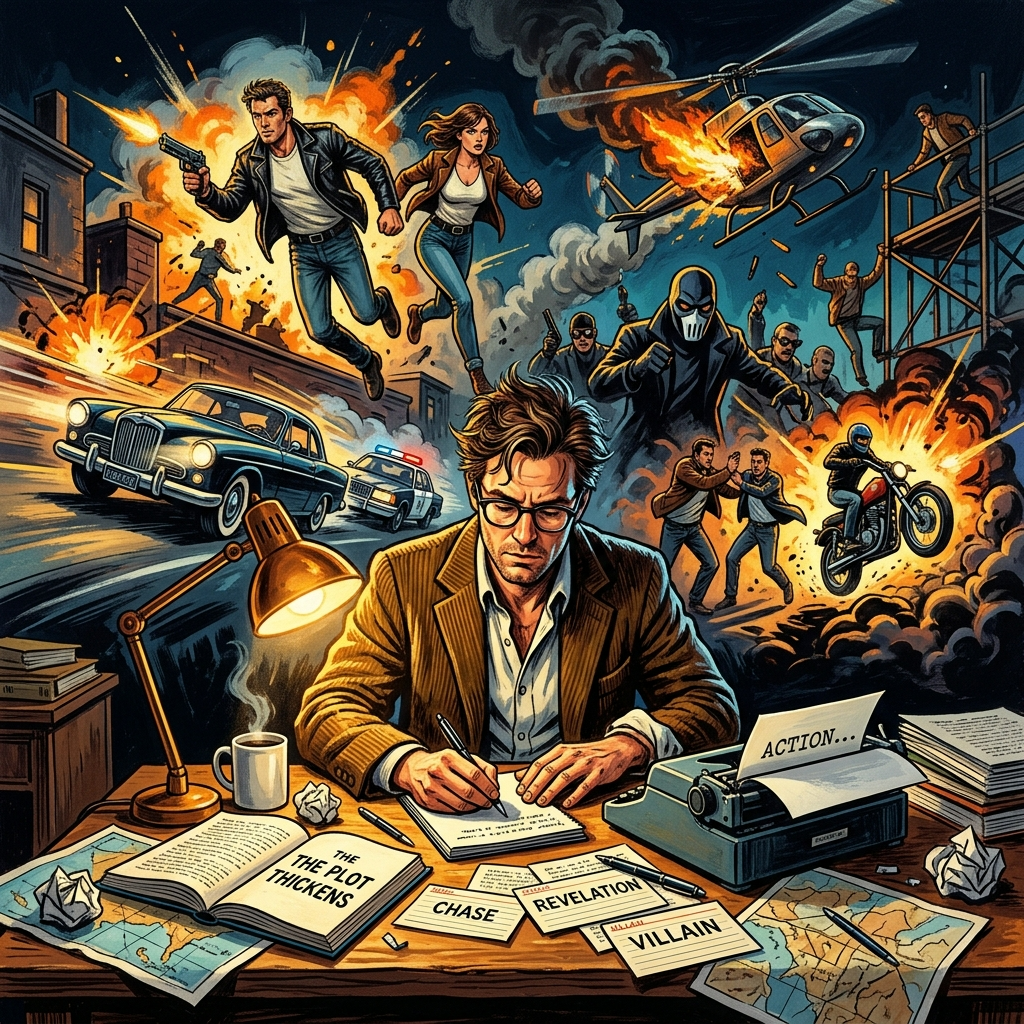
Words and Wonders Wednesdays: How to Plot an Action Story with the Action-ize Method!
Or, How I Learned to Stop Worrying and Blow Everything Up
Let me tell you something I’ve learned after forty-some years behind the screen. Most folks who sit down to write an action story make the same mistake. They start worrying about plot. They fret over motivations and backstories and whether the whole thing hangs together like a real novel ought to. And then they wonder why the whole thing feels flat. Here’s the thing about action — and Winston Churchill understood it even if he was talking about something else entirely. One person, or a small band of stubborn souls, standing up against odds that ought to flatten them, and refusing to lie down. That’s the whole heartbeat of the genre. Not the plot. The telling. So pull up a chair. Let me show you how we approach it over at the Scaldcrow Games table, using what we call the Action-ize Method! — principles drawn straight from the action movies that built the genre. These ideas work at any table, with any system. I first dug into this stuff in depth over in Bare Bones Multiverse, but everything here is wide open. Bring your own rulebook.
What Action Storytelling Actually Is
The genre got official recognition back in the 1970s, but you already know it in your bones. One hero. A pile of challenges that demand real physical feats. Extended fights. Nail-biting chases. A pace so unrelenting it never quite lets you catch your breath.
The world of an action story is a cold one. Military, political, and social rot everywhere you look. Atrocities go unavenged. Bad men do bad things and nobody answers for it — until your hero shows up to set one wrong right.
That’s the whole engine. Payback. Redemption. A reckoning.
Burn those three words into your notebook, because everything else grows out of them.
The Golden Rule of Plotting
Your one job as the storyteller is this: maintain a continuous chain of action.
Let the action move the story. Not the other way around. Every set piece should be over-the-top. You never let your hero rest, and you never let your players relax. The second things get comfortable, you throw another car through the window.
“But T. Glenn,” you say, “folks need a breather now and again.”
Sure they do. And film already taught us exactly how to handle that. You call for a montage.
When the pace needs a beat, you simply announce the party is preparing, gearing up, or training. That’s your montage — the hero sharpening the knife, loading the magazines, taping up the knuckles. You don’t play it out scene by scene. You call it, you sell it, and when the montage ends?
The action resumes. Every time.
How to Actionize Any Story
Here’s the part that trips people up. They think they need a brand-new idea. They don’t. In action, the story matters far less than how you tell it. You can take the most worn-out tale on the shelf and light a fuse under it.
Let me prove it with Little Red Riding Hood.
The way you know it: A young lady walks through the woods to Grandma’s house with a basket of goodies. She dodges the wolf and the dangers of the forest. She arrives to find the wolf got there first and ate poor Grandma up.
Cute. Simple. Familiar. Puts kids to sleep.
Now watch this. Little Red Riding Hood — Actionized: A mysterious young operative, code name
Red, gets a secret transmission from her old spec-ops command center, code name Grandma. The message reads: “The Wolf is at the Door. Deliver the goodies — all other operatives dead.”
There’s nobody else left. Red always blamed herself for the deaths of her old team at the hands of Tronto — The Wolf. This is her shot at making it right. So Red rounds up a ragtag crew of mercenary misfits known only as the Woodsmen, and they race to deliver the package to Grandma at a hidden depot deep in the South American jungle. She’s racing The Wolf himself, a legendary terrorist who’ll stop at nothing to see Grandma and the whole free world burn.
Same bones. Different beast entirely.
That’s the trick. Find the story you already know. Add a reckoning. Add stakes that won’t quit. Turn the wolf into a terrorist and the basket into the package that’ll save the world.
Casting Your People
Every good action tale runs on the right archetypes. You’ve seen every one of these faces before, and that’s exactly why they work.
- Company men and shadowy contacts
- Cops, retired cops, and war heroes
- Battle-hardened veterans who swore they were done with all of this
- Secret agents, soldiers, and spies
- Femmes fatales and old flames
- Idealists — usually the victims who get the whole thing rolling
- Drug dealers, military commanders, and old nemeses
- Even the humble storekeeper, because somebody’s got to run the shop when the shooting starts
Your hero, more often than not, is fed up with his life or running from his past. He left it all behind — until now. That “until now” is where your story begins.\
When you build these folks at the table, think about who they are before you think about what they can do. What broke them? What are they still carrying? What would it take to make them walk away — and what would make them turn back around?
Courageous. Defiant. Scarred. Reckless. Haunted. Vengeful. Pick the ones that fit, because those qualities drive every decision your character makes when the bullets start flying.
Picking Your Battlegrounds
Where you set the fight matters near as much as the fight itself. Action stories love a big, dramatic stage:
Behind enemy lines. Capital cities and drug dens. Exotic resorts and famous monuments. Festivals, parades, and military bases. Office buildings, prisons, and POW camps. Paramilitary training camps deep in the brush. Planes in the air, ships at sea, and trains barreling down the line.
Pick a place with height. With speed. With things that can break and burn. Then let your heroes tear through it.
Whatever system you’re using, the location is part of the story. Let it breathe. Let it threaten. Let your players feel like they’re somewhere that matters.
If It Can Blow Up, It Does Blow Up
Now we come to my favorite rule in this whole discussion, and I want you to write it on your wall.
If it can blow up, it does blow up.
Explosions are the lifeblood of the genre. When an attack strikes something with the potential to go boom, it goes boom. Every time. That fuel truck? Gone. Those barrels in the corner? Fireball. The helicopter? Don’t even ask.
This is not a physics simulation. Don’t treat it like one. Explosions are the genre’s punctuation mark. They tell your players that what just happened mattered. Use them freely and use them well.
Same spirit applies to how you handle action beats in general. Don’t get bogged down in granular accounting. What matters isn’t the exact specifications of every piece of gear. What matters is how hard it hits and how loud it lands.
Keep the momentum. Keep the noise. Keep moving.
The One-Liner Rule
Here’s something that’ll change your table, regardless of what game you’re running.
Action isn’t just muscle and gunpowder. It’s style. It’s the line the hero delivers right before the bad guy hits the pavement. The genre runs on those moments — the cool, the cocky, the perfectly timed quip that makes the whole table groan and grin at the same time.
So build a little table culture around it. When a crucial action lands, challenge your players to deliver the moment with the right line. It keeps everybody sharp, everybody leaning in, and everybody loving the pulp of it all.
You don’t need a mechanical reward to make it matter. The glory is its own prize.
What Got Me Thinking About All This
Now, I’ll be honest with you about where this particular piece came from.
We just released Black Dogs Pocket World over at Scaldcrow Games, and putting that together had me thinking hard about what makes action-driven storytelling tick at the tabletop level.
Black Dogs runs lean and mean — the kind of game that doesn’t ask you to slow down, doesn’t burden you with overhead, and trusts you to bring the thunder. Building it meant asking the same questions I’ve been chewing on for decades: What makes an action scene feel like an action scene? What’s the difference between a fight that gets forgotten and a fight the table talks about for years?
Writing Black Dogs Pocket World reminded me that the answers have always been the same. Keep the chain unbroken. Let the setting hit hard. Make every character somebody worth rooting for — or worth stopping. And when in doubt, blow something up.
If you haven’t grabbed a copy yet, go do that. Not because I’m biased — which I am — but because playing it will show you every principle in this article in live-fire action. Sometimes the best way to learn how to write the story is to play one first.
Load Up Your Research Reel
You want to get this stuff into your bones? Then do your homework the fun way. The action genre has been teaching storytellers how to do this for decades — all you’ve got to do is watch and learn. Pop some corn, take notes, and study how these films handle pace, character, and the fine art of never letting your heroes breathe:
- Die Hard (1988) — the gold standard for escalating set pieces and a hero who keeps getting back up
- The Bourne Identity (2002) — tight pacing, clear objectives, and a protagonist defined entirely by what he can’t remember
- Mad Max: Fury Road (2015) — nearly wall-to-wall action with character told almost entirely through behavior, not dialogue
- Predator (1987) — study how tension builds when the enemy is unseen, and how a capable team gets stripped down to one
- Raiders of the Lost Ark (1981) — the master class in stringing set pieces together without losing story momentum
- Lethal Weapon (1987) — two characters, real stakes, and the payoff of a hero who genuinely has nothing left to lose
- Rambo: First Blood (1982) — how a reckoning works when the hero is both right and dangerous
- Enter the Dragon (1973) — a clean three-act structure wrapped around a tournament; study the setup and the slow reveal of stakes
- The Terminator (1984) — relentless pursuit, an unstoppable antagonist, and a hero forced to improvise under impossible pressure
- True Lies (1994) — escalation done right, with each act raising the stakes higher than the last
Watch how the pace escalates but never collapses. Watch how quiet moments aren’t rest — they’re the deep breath before the next explosion. Watch how the hero absorbs punishment that ought to end him, and then gets back up anyway. Watch the escalation — how each act raises the stakes higher than the last, until the final confrontation feels earned rather than accidental.
That’s your masterclass, right there on the screen.
Now Go Actionize Something
So there’s the whole recipe. Keep the action moving. Lean on payback, redemption, and a reckoning. Take a story you already know and light a fuse under it. Cast the right faces, pick a stage worth wrecking, and remember — if it can blow up, it does.The plot was never the hard part, friend. The telling is everything.Now get to your table, whatever table that is, and go set some wrong right.For more Words and Wonders Wednesdays and action-pulp storytelling tools, keep prowling Scaldcrow Games — the fire’s lit, the dice are warm, and there’s always another reckoning waiting down the road.
Want more Gamer? Look no further! Check out our other articles in our blog’s ARTICLE INDEX.